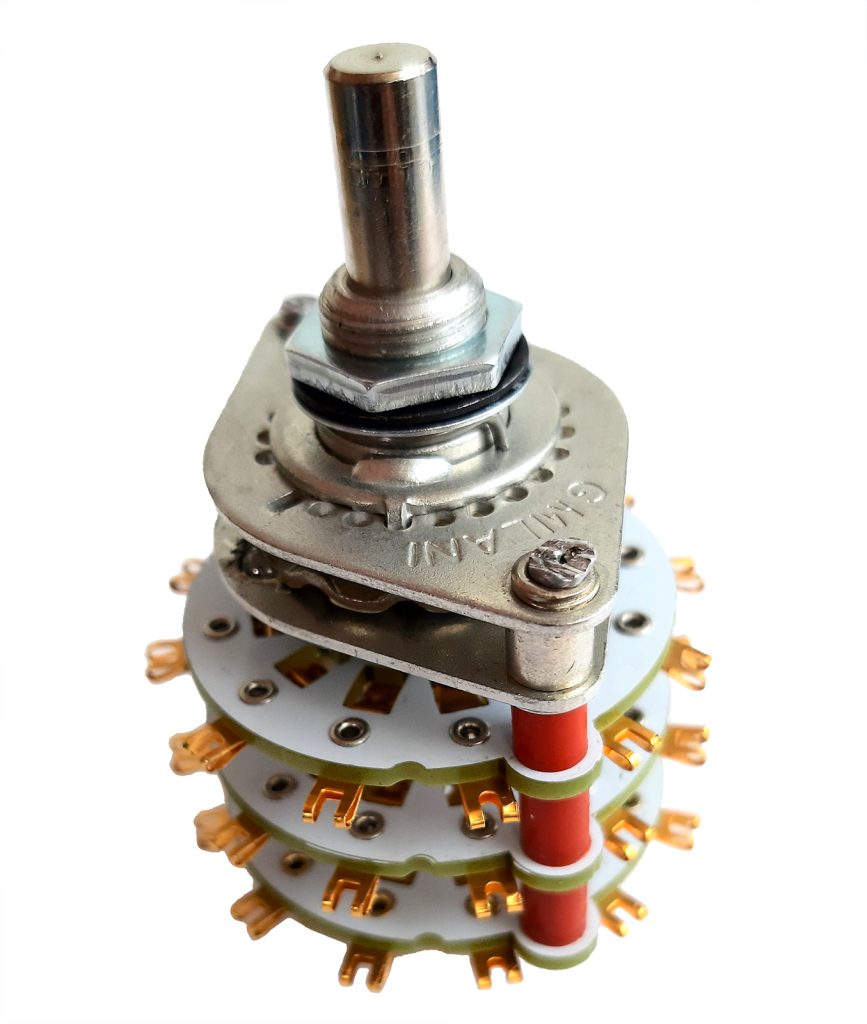
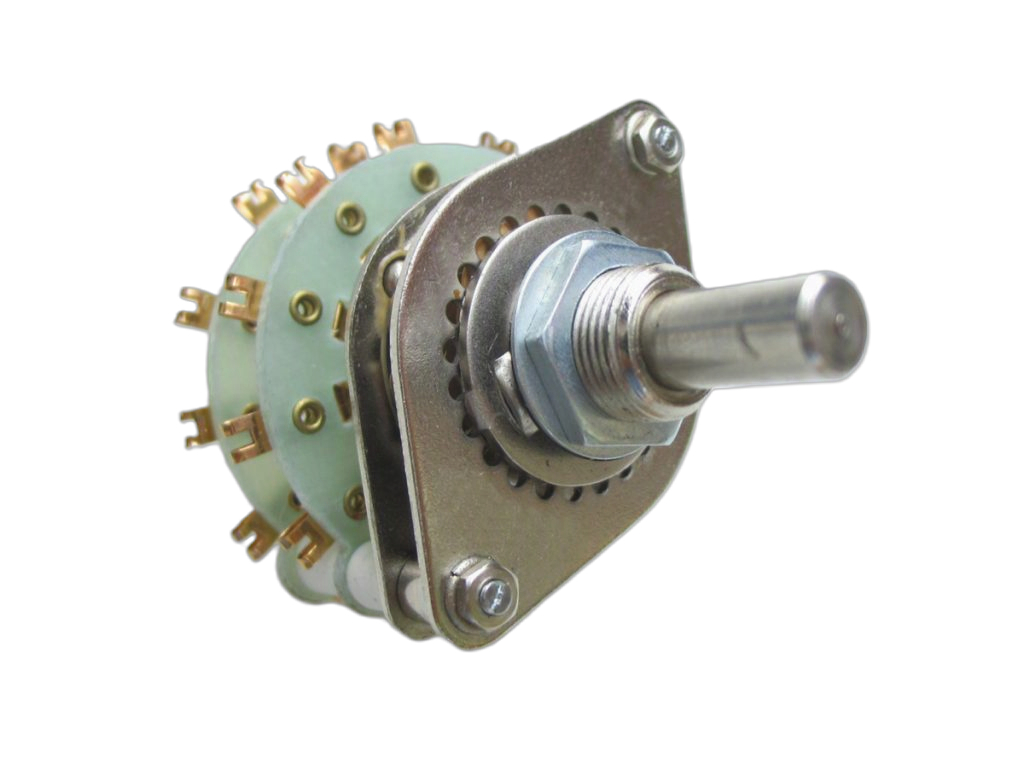
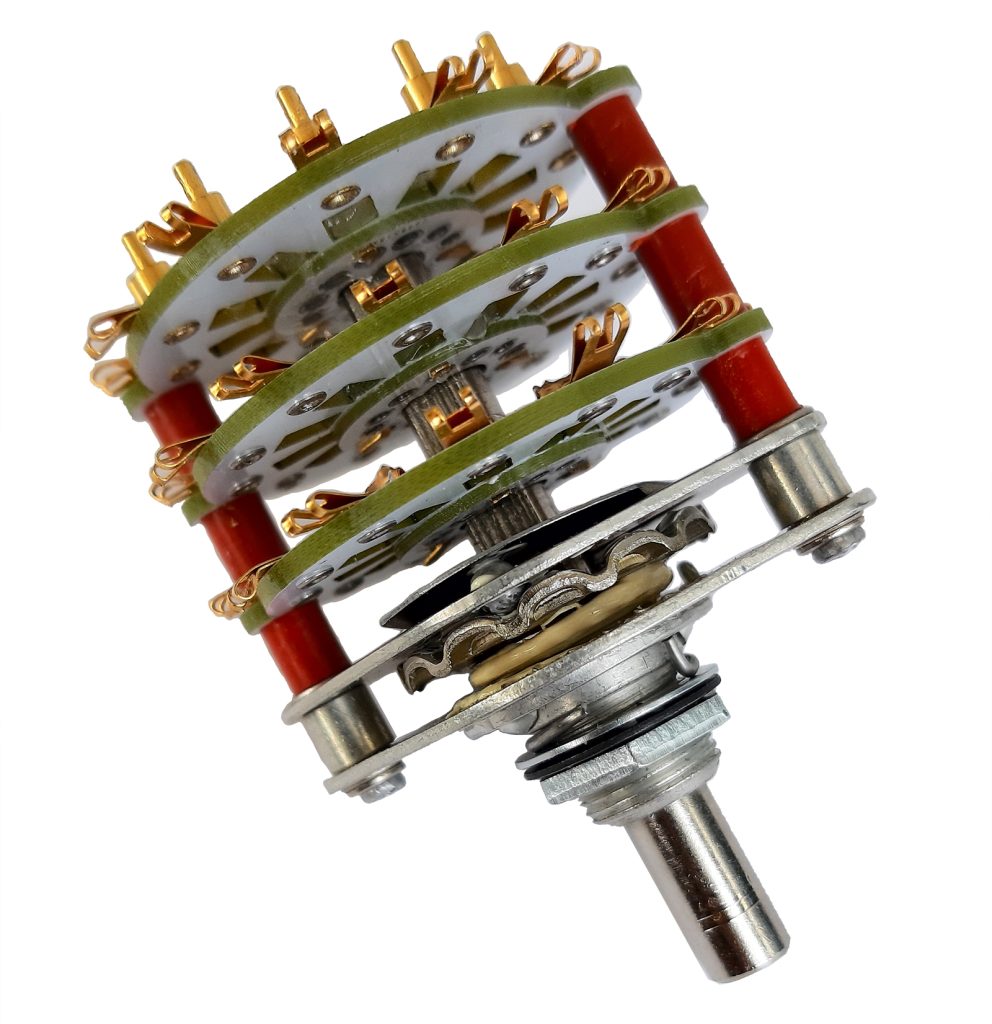
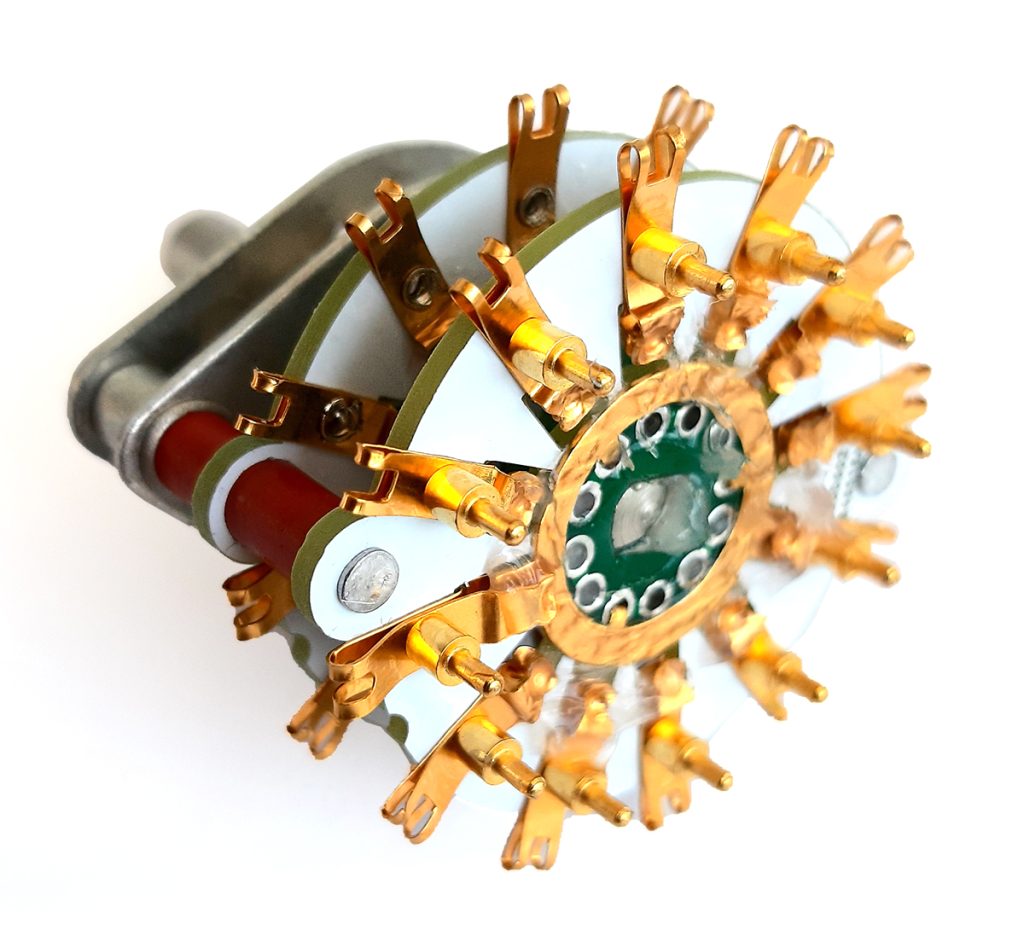
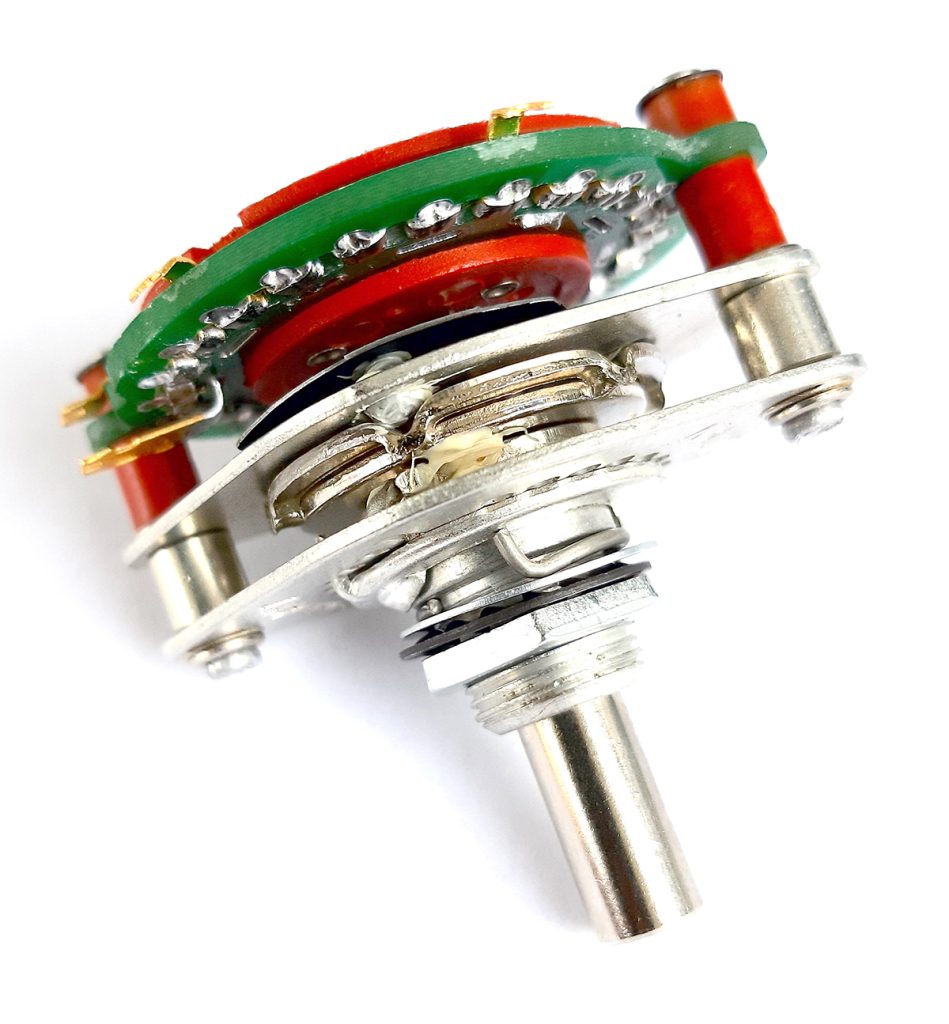
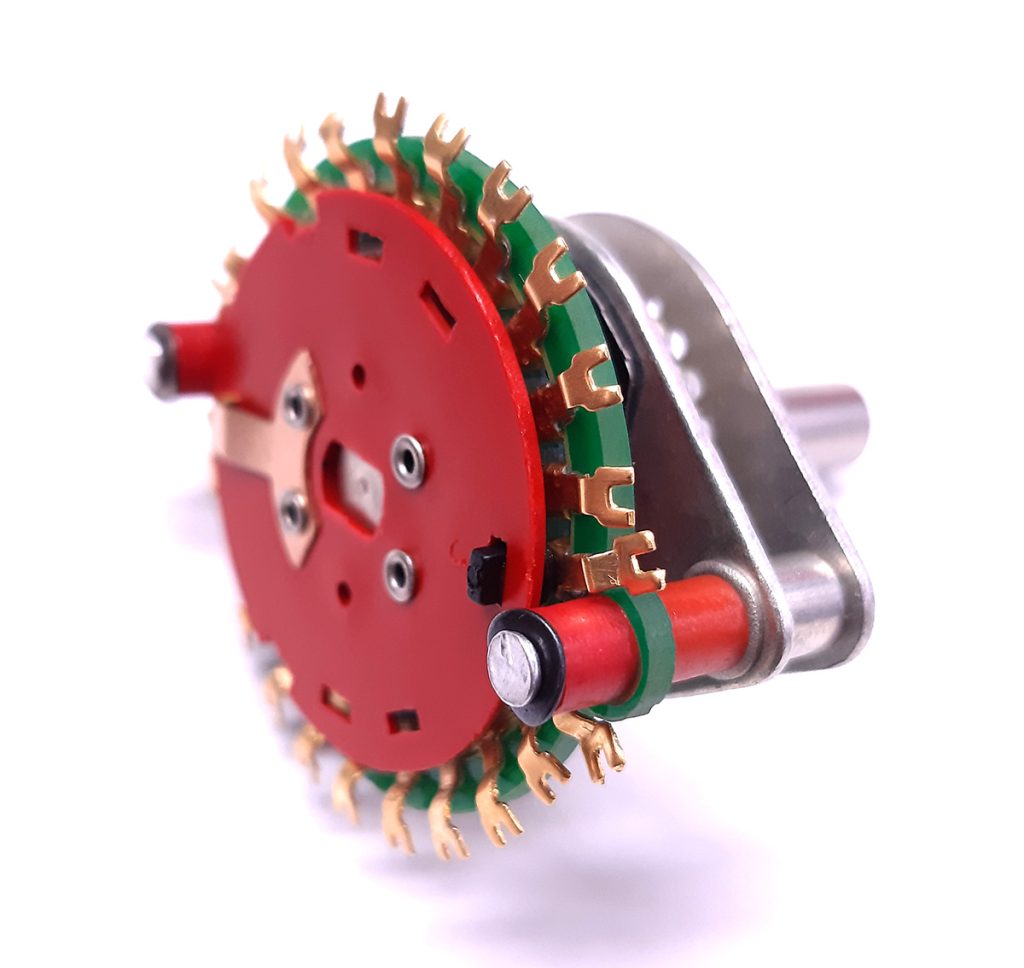
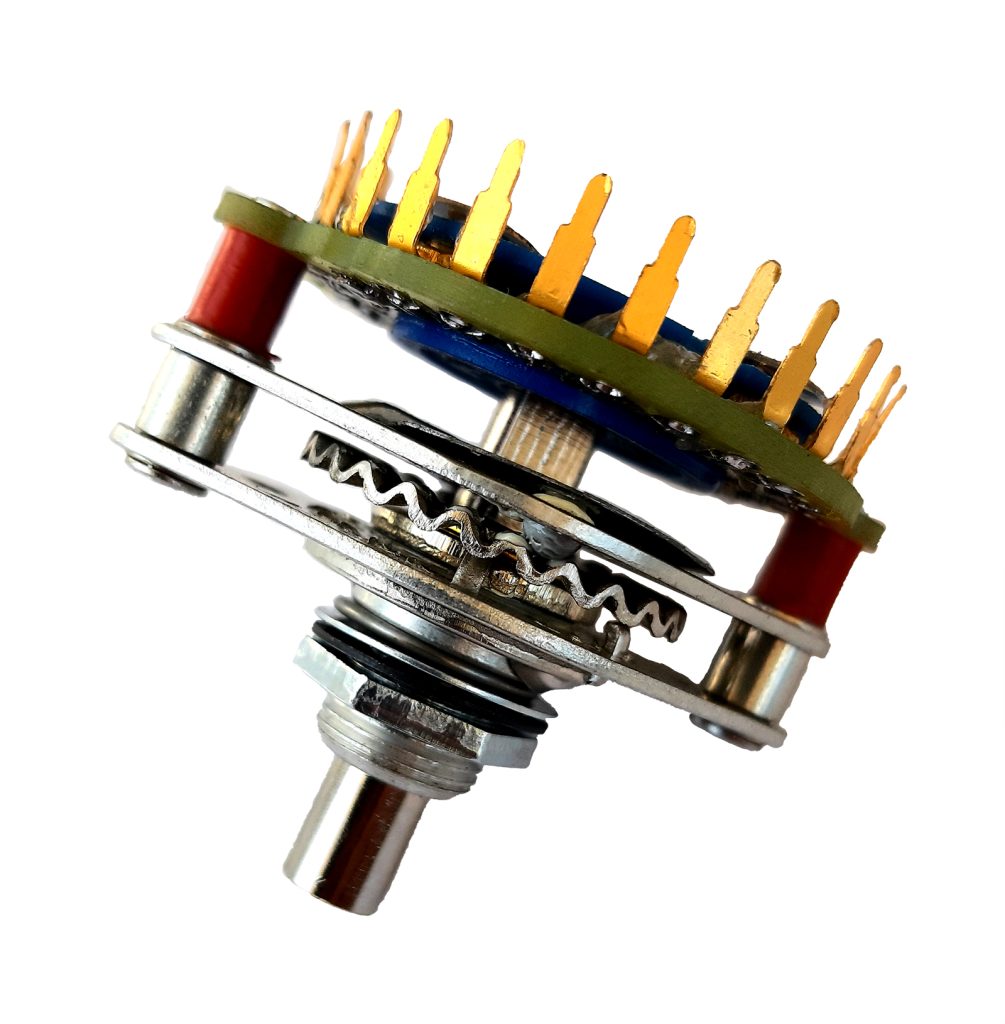
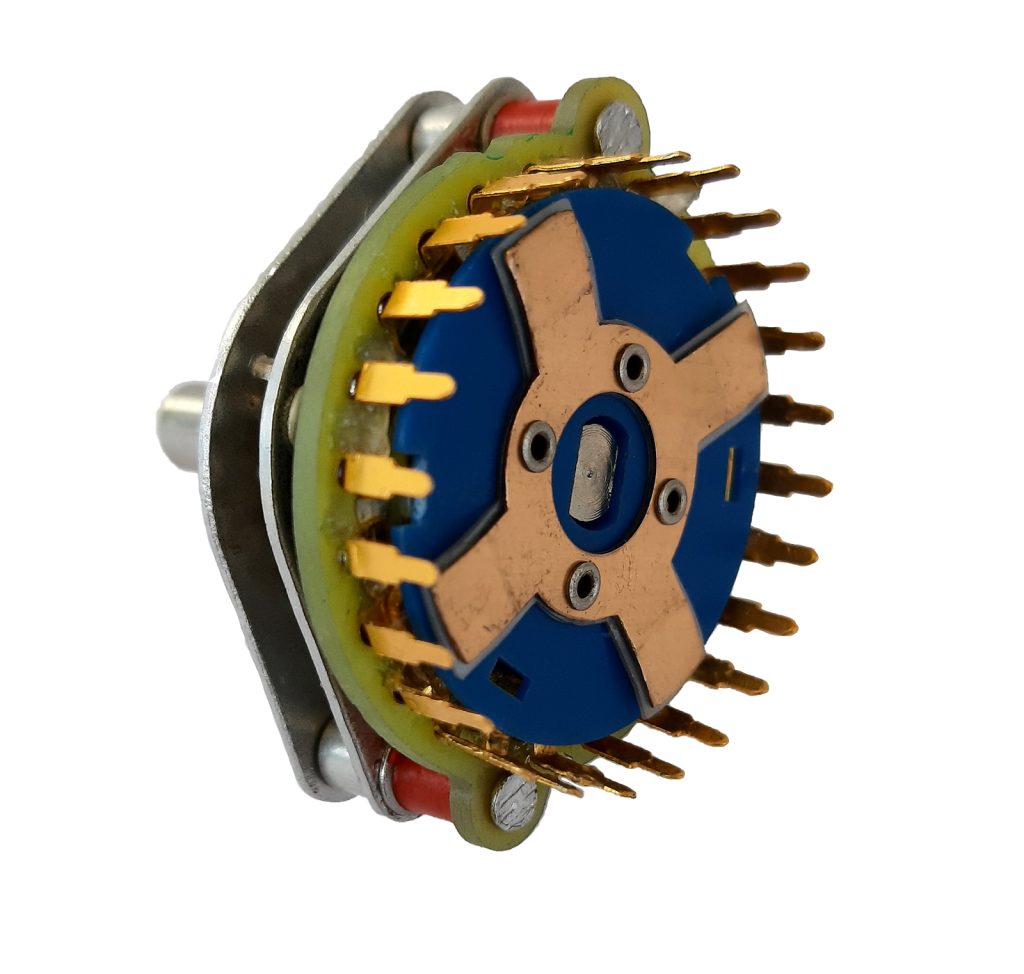
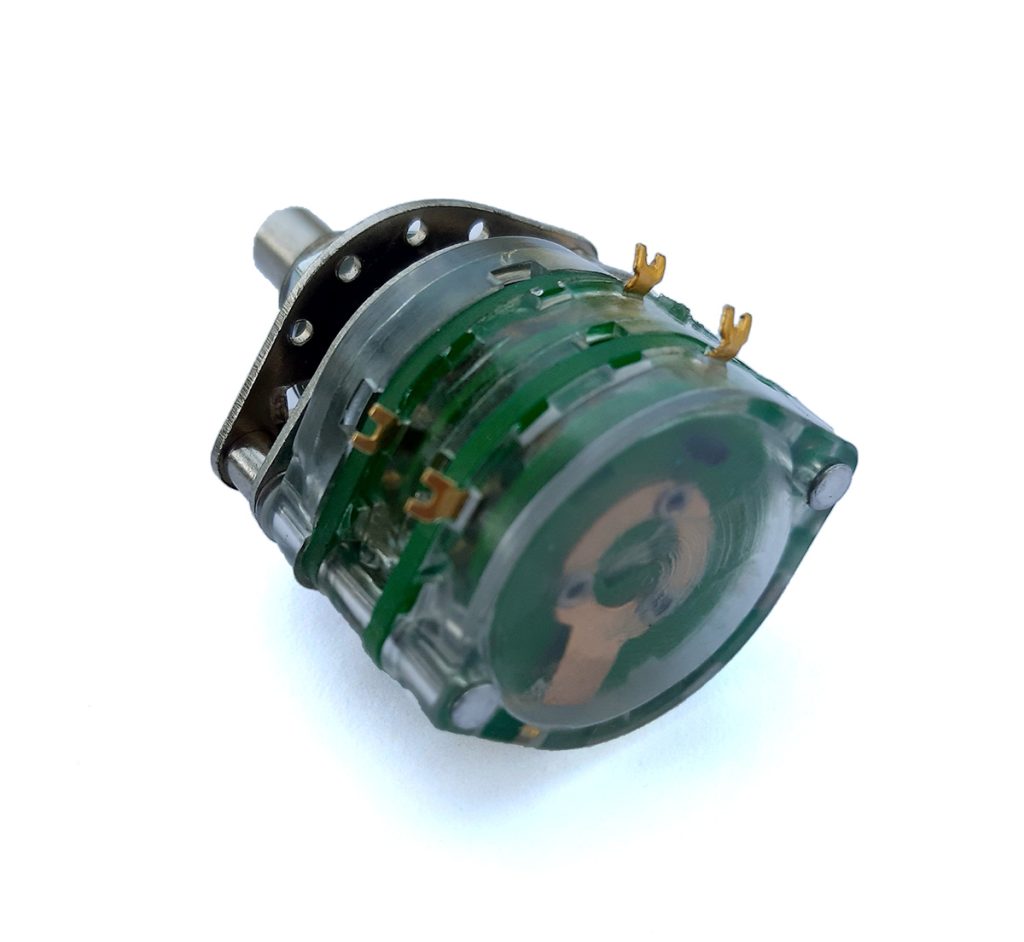
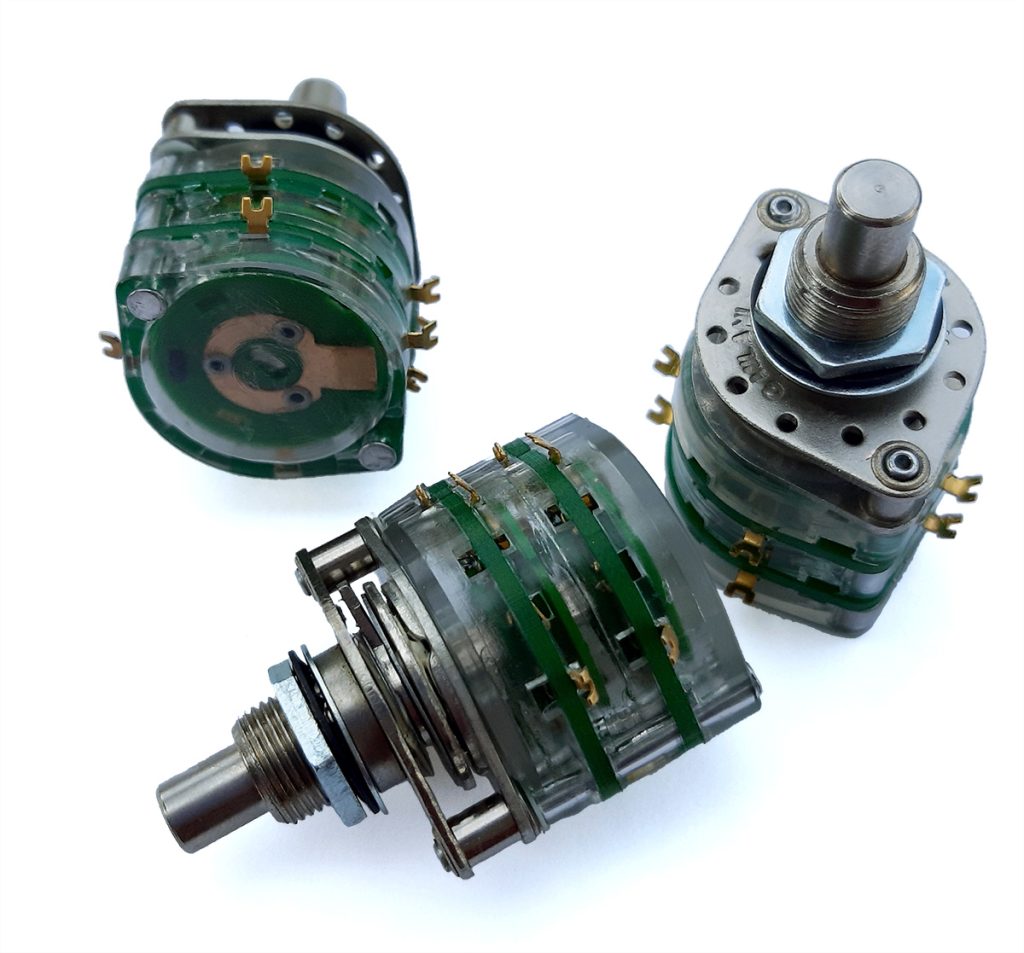
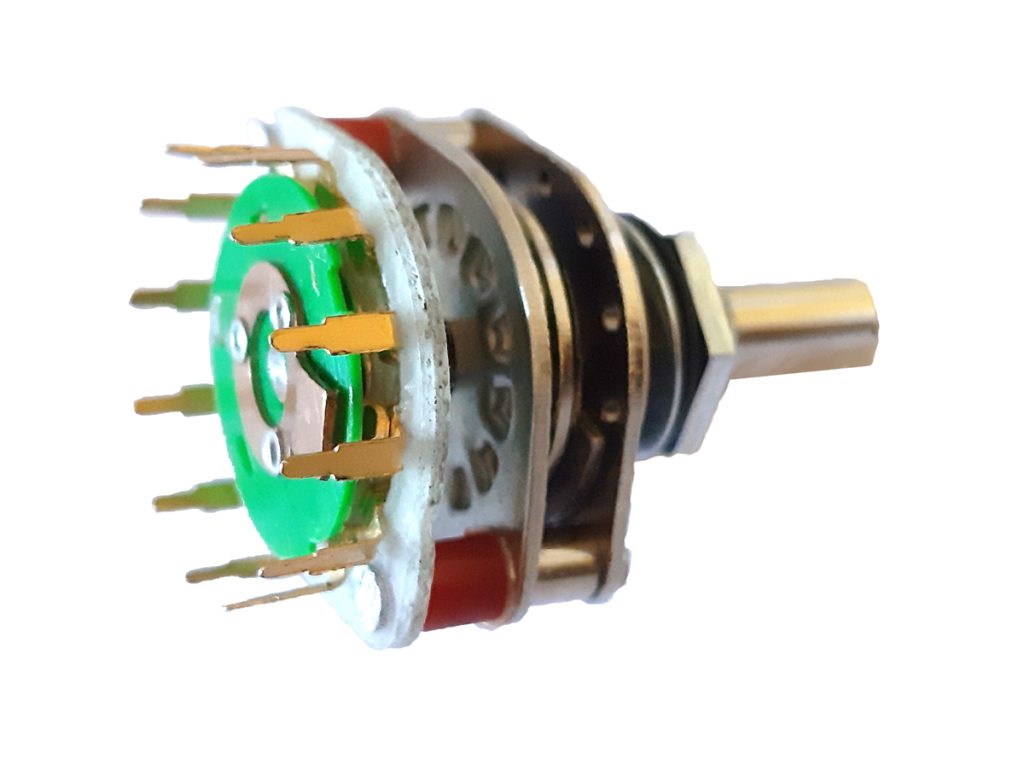
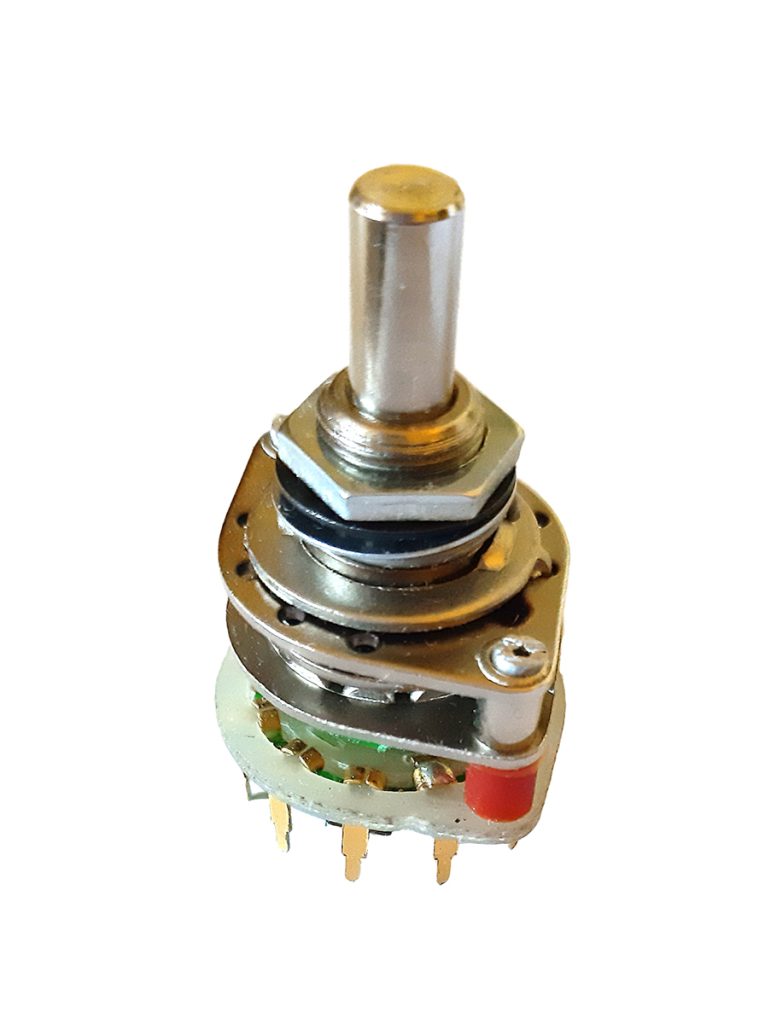
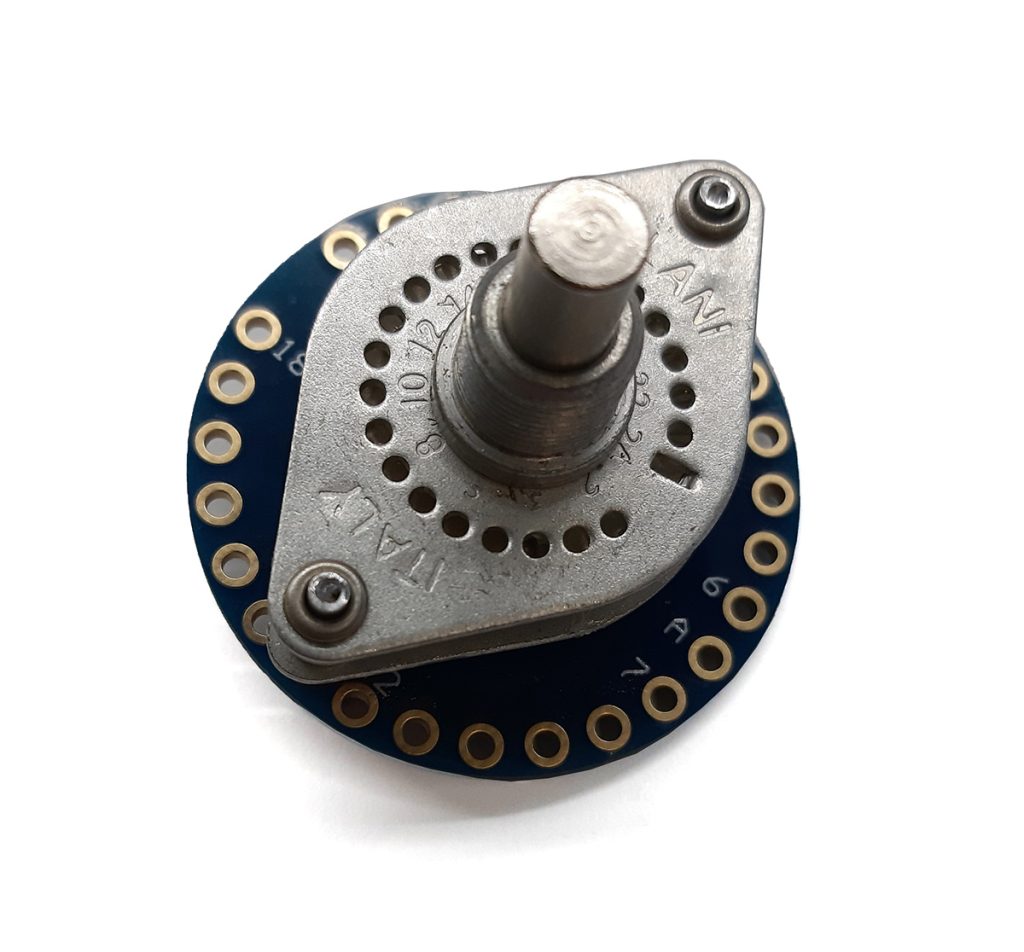
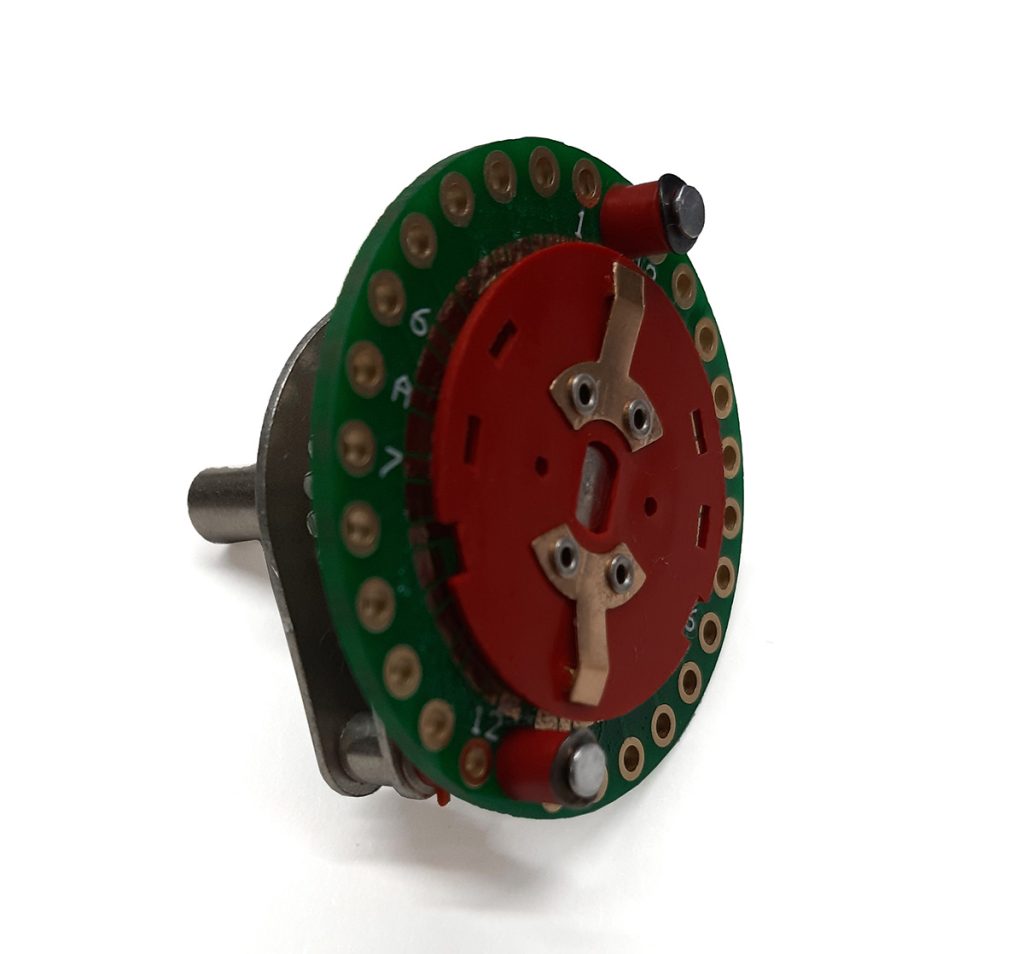
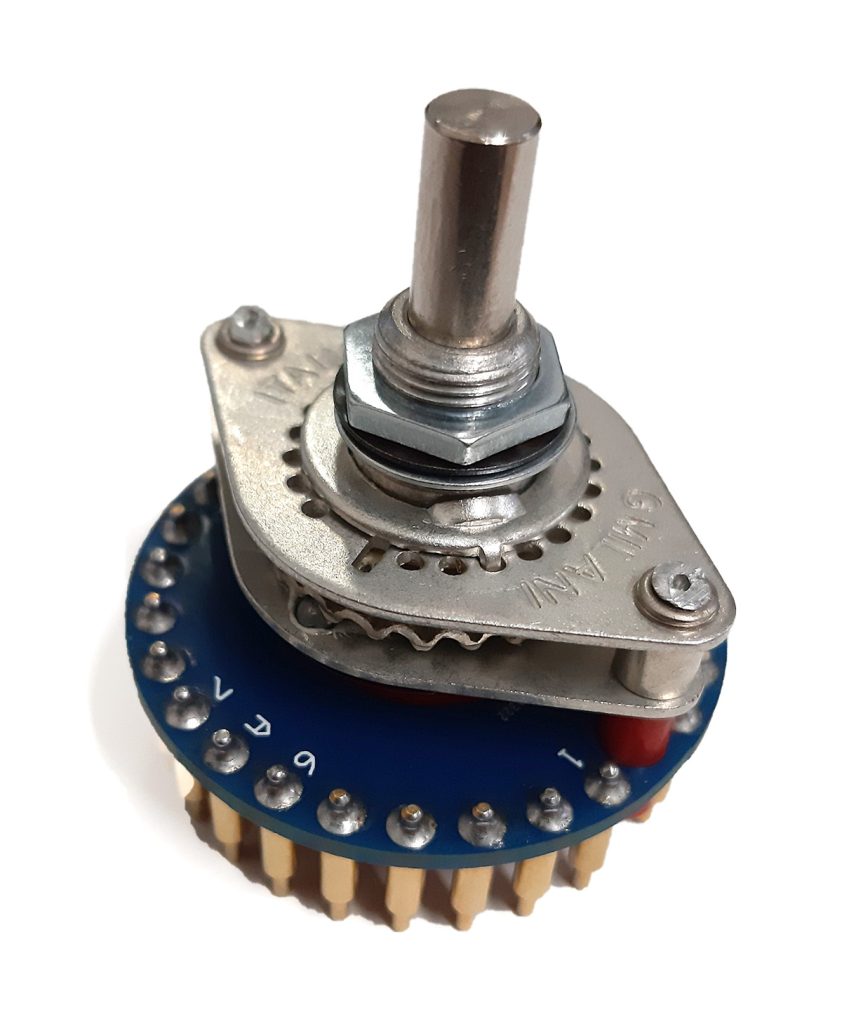
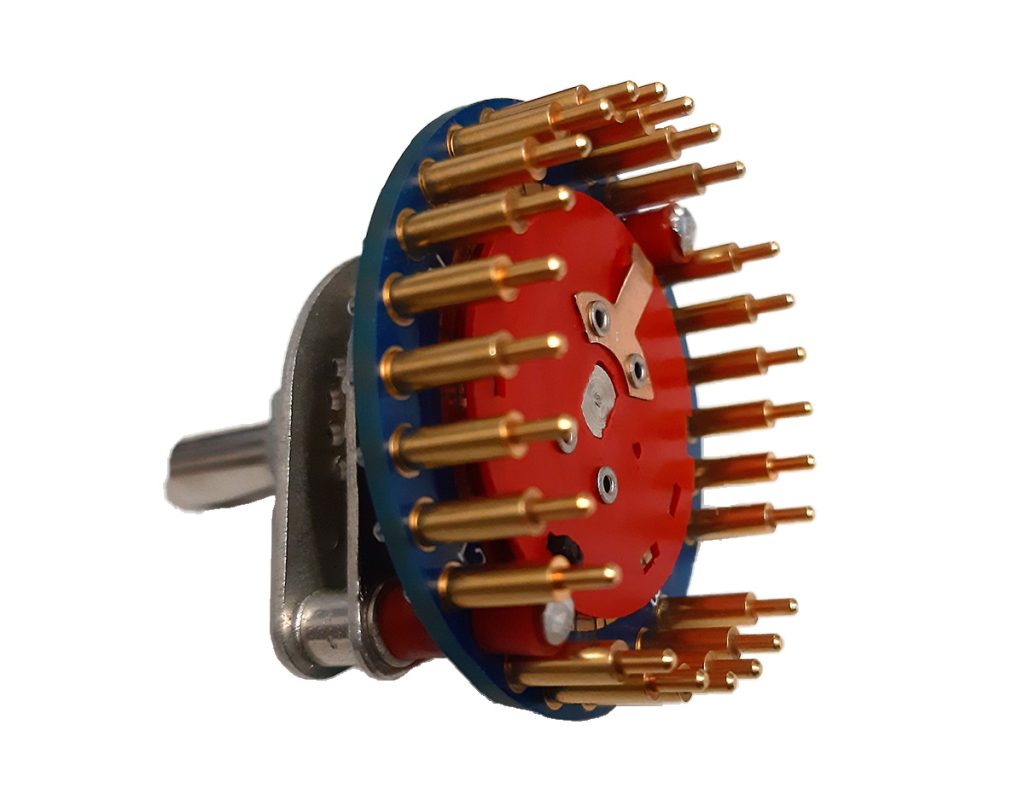
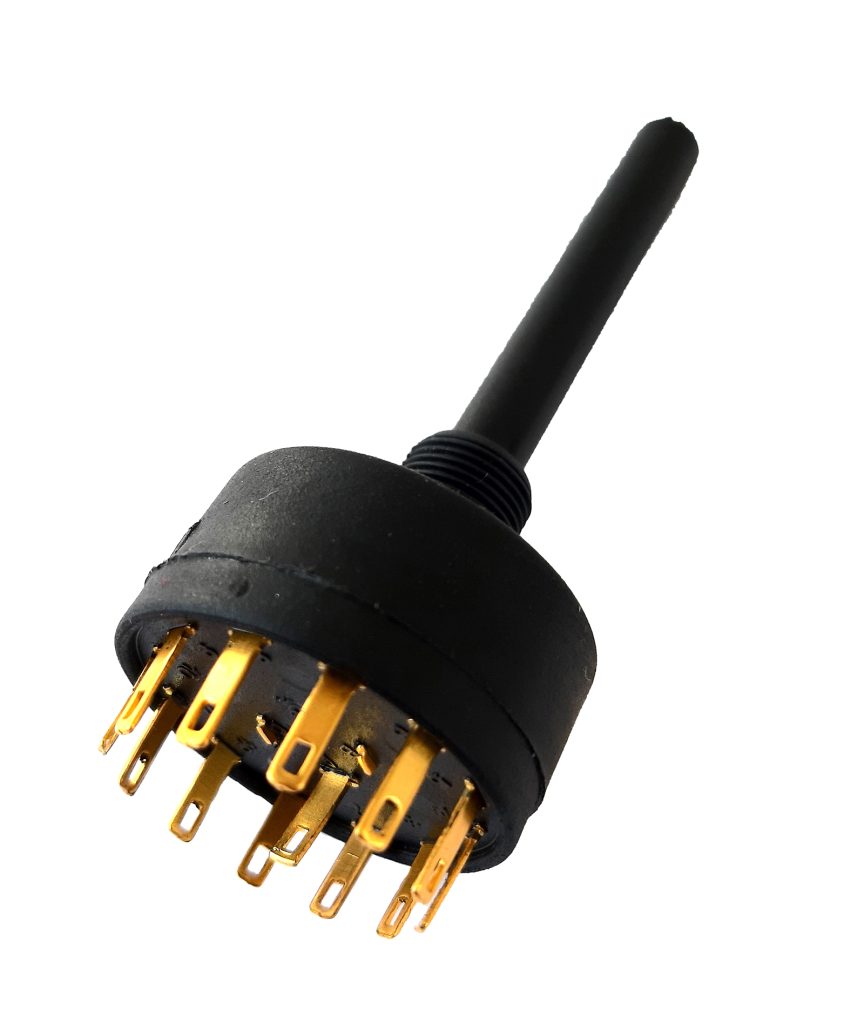
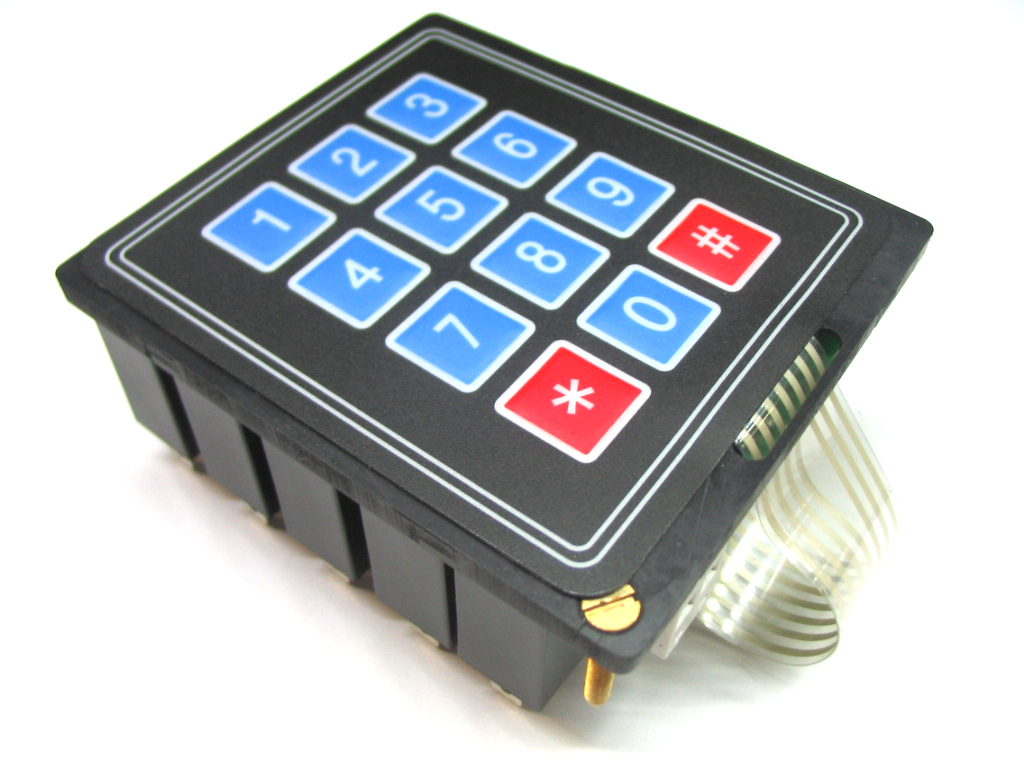
Rotary Switches

From cost-effective models to high-end professional solutions
Precision, Reliability, Made in Italy

Our rotary switch range covers every application: from compact, economical units to high-precision professional models engineered for demanding environments. Designed and manufactured entirely in Italy, they deliver long-term reliability, tactile accuracy and consistent performance across medical devices, audio systems, measurement equipment and industrial electronics.

⭐ PREMIUM

PRO PRO

PRO

Gold-plated contacts

Adjustable end-stop

Double O-ring sealing

PRO — Features

PRO — Technical Details

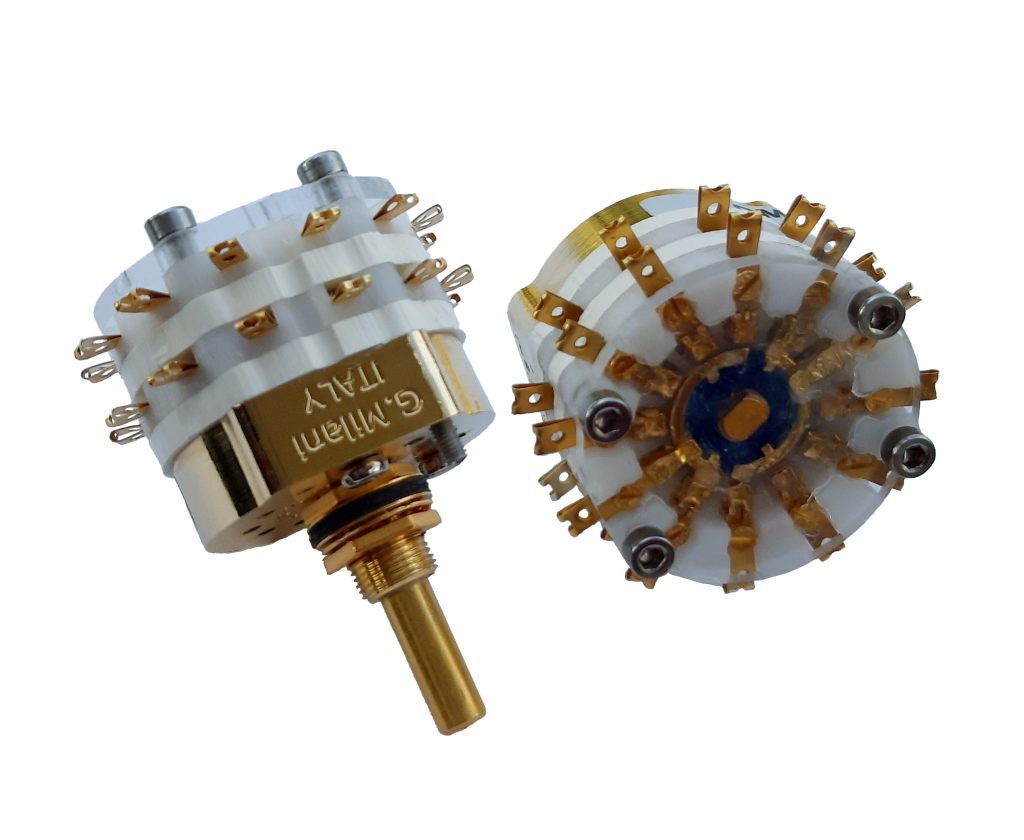
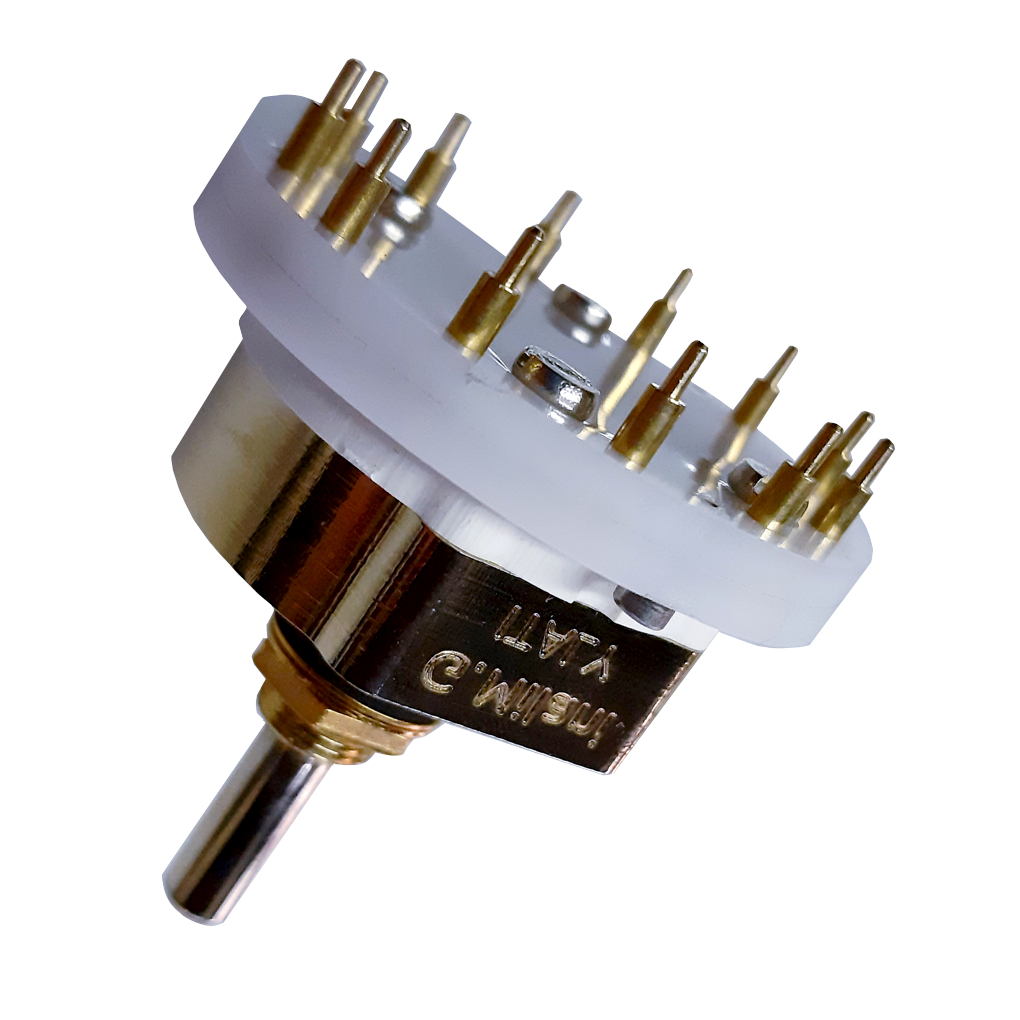
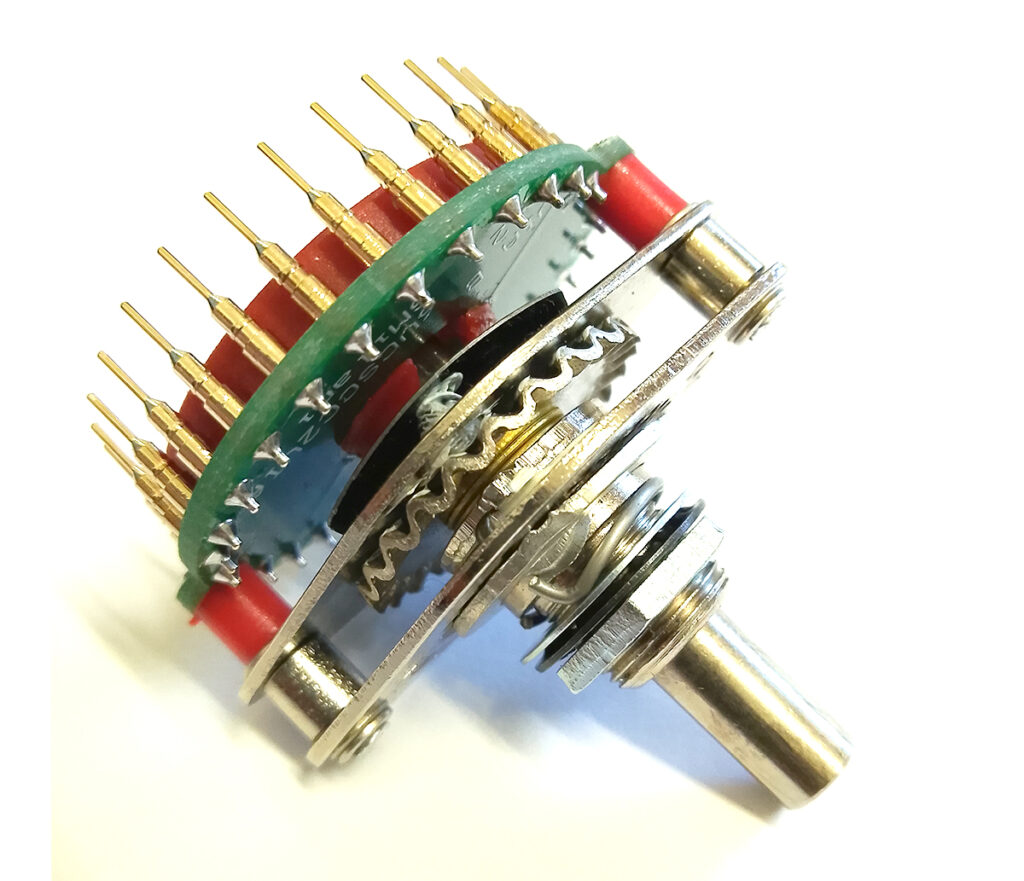
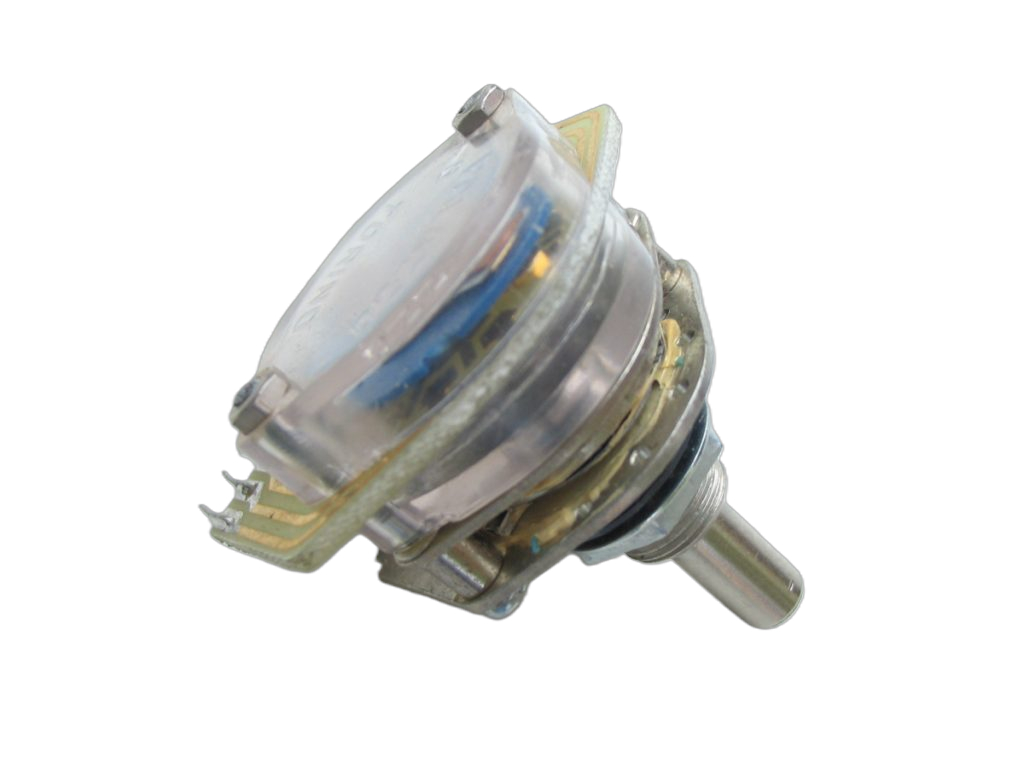
High-end handcrafted rotary switches for electronic and HI-FI applications, individually tested and built with premium materials. The detent mechanism is light yet firm, completely free of play, ensuring long-term durability and exceptional contact precision.

Contacts are secured with screw-and-nut fastening, providing a strong clamping effect and allowing replacement when needed. End-stop braking is adjustable by repositioning a dedicated screw.

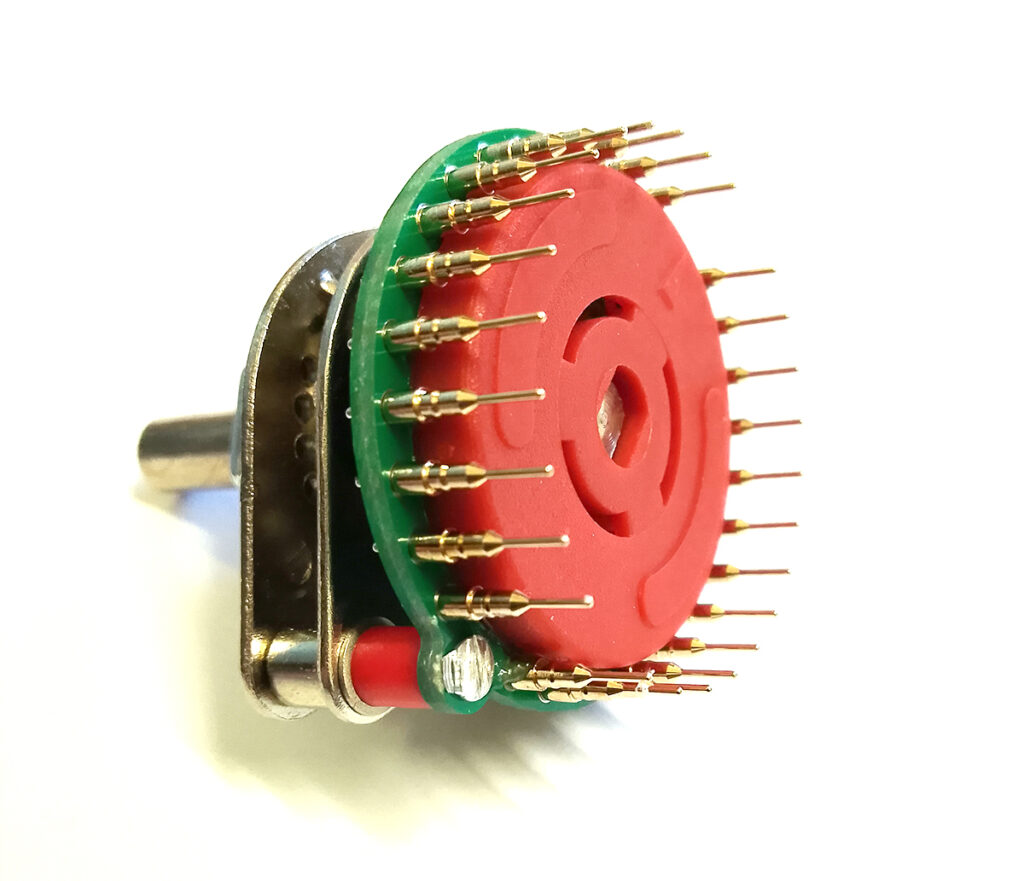
Silver-plated and subsequently gold-plated contacts ensure extremely low contact resistance and superior protection against oxidation. A PCB-terminal version is also available.

Premium materials

  • Gold-protected brass shaft, support and flywheel
  • Brass and nickel-plated steel screws
  • Phosphor-bronze contacts, silver-plated then gold-plated
  • Contact carrier in natural Delrin® acetal resin

Main features

  • Shaft diameter: 6 mm ± 0.01
  • Sealed construction with double O-ring on the shaft
  • Gold-plated screw-fastened contacts, replaceable
  • Non-shorting contacts (shorting on request)
  • Tweezer-type contact system
  • Adjustable end-stop brake
  • Detent angle: 30°
  • Detent torque: 0.75 kg·cm

Electrical & mechanical ratings

  • Switching capacity (resistive load): 0.5 A @ 230 Vac, 1.5 A @ 30 Vdc
  • Insulation (contacts to ground): 2500 Vac for 1 min
  • Initial contact resistance: < 8 mΩ (maximum)
PRO PRO
PTZ PTZ

PTZ

Gold-plated internal brush

27-step precision mechanism

SMD 1% film resistors

PTZ — Features

PTZ — Technical Details

High-end stepped attenuator for electronic and HI-FI applications, built with professional-grade construction and individually tested. Features SMD film resistors (1% precision) and a gold-plated internal brush for extremely low contact resistance.

Offers 27 detent positions at 12°, with optional intermediate loudness tap (I). Maximum configuration: 4 sections.

Mechanical construction

  • Gold-treated brass body
  • Ball-bearing mechanical support
  • Sealed panel-mount design
  • Sliding brush, silver-plated then gold-plated

Electrical characteristics

  • Available curves: linear or logarithmic
  • Available values (Ω): 5k, 10k, 20k, 50k, 100k, 250k, 500k, 750k, 1M
  • Switching capacity: 0.5 A @ 230 Vac, 1.5 A @ 30 Vdc
  • Insulation: 2500 Vac for 1 min (contacts to ground)
  • Contact resistance: < 8 mΩ (maximum initial value)

Additional features

  • Non-shorting contacts (shorting on request)
  • Gold-plated screw-fastened contacts, replaceable
  • 6 mm shaft diameter
  • Detent angle: 12° per step
  • Detent torque: 0.75 kg·cm
PTZ PTZ

⚙️ STANDARD

1V 1V

1V

Up to 11 positions

Up to 4 poles

With solder-lug terminals

1V — Features

1V — Technical Details

Signal rotary switches with very low contact resistance and an elastic tweezer-type contact system. Modular construction with up to 4 sections, each providing a defined number of positions depending on the pole configuration.

Switching Configurations

  • 1 pole — 11 positions per section
  • 2 poles — 5 positions per section
  • 3 poles — 3 positions per section
  • 4 poles — 2 positions per section
  • Maximum: 4 sections

Standard versions feature non-shorting contacts. Shorting versions available on request.

Mechanical Features

  • Elastic tweezer-type contact system
  • Movable stop
  • Standard detent torque: 1.0–1.5 kg·cm
  • Other torque values available on request
  • Protective contact cap
  • Terminal holes: 0.9 × 1.8 mm

HV Version (Optional)

  • Insulated shaft in polyester-glass material (up to 4 sections)
  • Nylon mounting screws (up to 1 section)

Sealed Version

  • Shaft O-ring
  • Internal seal inside threaded bushing
  • Nitrile rubber rear sealing washer

Dimensions

  • 1-pole, 1-section switch length: 21 mm
  • Add 8.5 mm for each additional section

Electrical & Mechanical Ratings

  • Switching capacity (resistive load): 0.3 A @ 220 Vac, 1.3 A @ 30 Vdc
  • Initial contact resistance: < 5 mΩ
  • Insulation (1-pole type): 1300 Vac, 100×10⁹ Ω
  • Mechanical life: > 300,000 operations (with load = 10% of rated value)
1V 1V
1VCS 1VCS

1VCS

Up to 11 positions

Up to 4 poles

For PCB mounting

1VCS — Features

1VCS — Technical Details

Signal rotary switches with low-resistance tweezer-type contacts and internal movable stop. Mechanical and electrical characteristics correspond to the standard 1V series, with the addition of turned terminals for improved mechanical strength.

In this version, the fixing eyelets of the last section (as in the 1V type) are replaced by turned terminals. Their mechanical robustness allows the switch to be firmly mounted by the control shaft alone, without requiring panel screws.

The insulating support corresponds to an FR4 PCB section.

Switching Configurations

  • 1 pole — 11 positions per section
  • 2 poles — 5 positions per section
  • 3 poles — 3 positions per section
  • 4 poles — 2 positions per section
  • Maximum: 4 sections

Mechanical Features

  • Elastic tweezer-type contact system
  • Movable stop
  • Standard detent torque: 1.0–1.5 kg·cm
  • Other torque values available on request
  • Non-shorting contacts (shorting on request)

Sealed Version

  • Shaft O-ring
  • Internal seal inside threaded bushing
  • Nitrile rubber rear sealing washer

HV Version (Optional)

  • Insulated shaft in polyester-glass material (up to 4 sections)
  • Nylon mounting screws (up to 1 section)

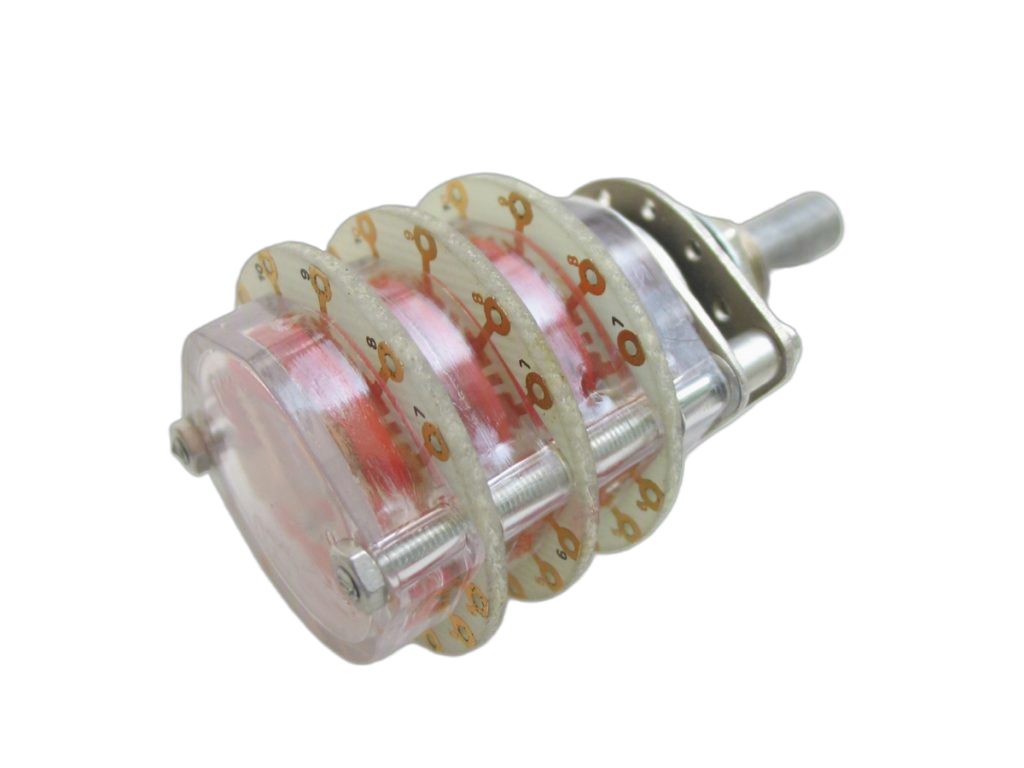
Mixed Sections (as shown in photo)

  • Additional wiring sections can be mounted between the detent group and the FR4 section
  • These can be connected to the PCB section using short rigid wires
  • Standard height: 19 mm (customizable, minimum 17 mm)

Electrical & Mechanical Ratings

  • Switching capacity (resistive load): 0.3 A @ 220 Vac, 1.3 A @ 30 Vdc
  • Initial contact resistance: < 5 mΩ
  • Insulation: 1300 Vac, 100×10⁹ Ω
  • Mechanical life: > 300,000 operations (with load = 10% of rated value)
1VCS 1VCS
2V 2V

2V

Up to 24 positions

Up to 4 poles

With solder-lug terminals

2V — Features

2V — Technical Details

Rotary switches with a low-resistance sliding-shoe contact system and internal movable stop. All contacts are shorting. For non-shorting versions with 15° detent and 24 positions, the dedicated 6V series is available.

Switching Configurations

  • 1 pole — 24 positions per section
  • 2 poles — 12 positions per section
  • 3 poles — 8 positions per section
  • 4 poles — 6 positions per section
  • Maximum: 4 sections

Standard detent angle: 15°. Detent angles of 30°, 60°, 90° available on request.

Mechanical Features

  • Sliding-shoe contact system
  • Movable stop
  • Detent torque: 1.5 or 2.0 kg·cm (other values on request)

HV Version (Optional)

  • Insulated shaft in polyester-glass material (up to 4 sections)
  • Nylon mounting screws (up to 1 section)

Sealed Version

  • Shaft O-ring
  • Internal seal inside threaded bushing
  • Nitrile rubber rear sealing washer

Dimensions

  • Base length: 21 mm
  • Add 8.5 mm for each additional section

Electrical & Mechanical Ratings

  • Switching capacity (resistive load): 0.9 A @ 220 Vac, 4 A @ 30 Vdc
  • Initial contact resistance: < 9 mΩ
  • Insulation: 1400 Vac, 200×10⁹ Ω
  • Mechanical life: > 200,000 operations (with load = 10% of rated value)
2V 2V
2VCS 2VCS

2VCS

Up to 23 positions

Up to 4 poles

For PCB mounting

2VCS — Features

2VCS — Technical Details

Single-section rotary switches for signal and low-power applications, featuring a low-resistance sliding-shoe contact system and internal movable stop. All contacts are shorting in the 15° version. For non-shorting PCB versions, the dedicated 6VCS series is available.

In these models, the pole contacts are part of the 24 terminals arranged on a 32.5 mm diameter. Their exact position is defined in the switching table and technical drawing.

Switching Configurations

  • 1 pole — 23 positions, pole in A
  • 2 poles — 11 positions, poles in A, D
  • 3 poles — 7 positions, poles in A, C, E
  • 4 poles — 5 positions, poles in A, B, D, F

Standard detent angle: 15°. Detent angles of 30°, 60°, 90° available on request.

Mechanical Features

  • Sliding-shoe contact system
  • Movable stop
  • Detent torque: 1.5 or 2.0 kg·cm (other values on request)

HV Version (Optional)

  • Insulated shaft in polyester-glass material (up to 4 sections)
  • Nylon mounting screws (up to 1 section)

Sealed Version

  • Shaft O-ring
  • Internal seal inside threaded bushing
  • Nitrile rubber rear sealing washer

Mixed Sections (as shown in photo)

  • Additional wiring sections can be mounted between the detent group and the PCB section
  • These can be connected to the PCB using short rigid wires

Dimensions

  • Base height: 21 mm
  • Custom heights available (minimum 17 mm)

Electrical & Mechanical Ratings

  • Switching capacity (resistive load): 0.9 A @ 230 Vac, 4 A @ 30 Vdc
  • Initial contact resistance: < 9 mΩ
  • Insulation: 1400 Vac, 200×10⁹ Ω
  • Additional insulation value: 1300 Vac, 100×10⁹ Ω
  • Mechanical life: > 200,000 operations (with load = 10% of rated value)
2VCS 2VCS
4V 4V

4V

Up to 12 positions

Up to 4 sectors

With solder-lug terminals

4V — Features

4V — Technical Details

Compact rotary switches for signal and low-power applications, featuring a sliding-shoe contact system and internal movable stop. All contacts are shorting.

Switching Configurations

  • 1 pole — 12 positions per section
  • 2 poles — 6 positions per section
  • 3 poles — 4 positions per section
  • Maximum: 4 sections

Standard detent angle: 30°. Detent angles of 60° or 90° available on request.

Mechanical Features

  • Sliding-shoe contact system
  • Movable stop
  • Detent torque: 1.2–1.7 kg·cm (other values on request)

HV Version (Optional)

  • Insulated shaft in polyester-glass material (up to 2 sections)
  • Nylon mounting screws (up to 1 section)

Sealed Version

  • Shaft O-ring
  • Internal seal inside threaded bushing
  • Nitrile rubber rear sealing washer

Dimensions

  • Base height: 23 mm
  • Add 7.5 mm for each additional section

Electrical & Mechanical Ratings

  • Switching capacity (resistive load): 0.9 A @ 220 Vac, 4 A @ 30 Vdc
  • Initial contact resistance: < 9 mΩ
  • Insulation: 1300 Vac, 150×10⁹ Ω
  • Mechanical life: > 200,000 operations (with load = 10% of rated value)
4V 4V
4VCS 4VCS

4VCS

Up to 11 positions

Up to 3 poles

For HI-FI applications

4VCS — Features

4VCS — Technical Details

New high-end rotary switch series for electronic and HI-FI equipment, handcrafted with professional-grade methods and individually tested. The detent mechanism is light yet precise, with zero play, ensuring long-term durability and excellent contact accuracy.

Contact terminals are secured with a screw-and-nut system, providing a strong “clamping effect” and allowing replacement if required. The end-stop can be adjusted to suit different applications.

Pole contacts are part of the 12 terminals arranged on a 23.5 mm diameter. Their exact position is defined in the switching table and technical drawing.

Switching Configurations

  • 1 pole — 11 positions, pole in A
  • 2 poles — 5 positions, poles in A, C
  • 3 poles — 3 positions, poles in A, B, D

Mechanical Features

  • Sliding-shoe contact system
  • Movable stop
  • Adjustable end-stop
  • Protective discs supplied for transport and storage

HV Version (Optional)

  • Insulated shaft in polyester-glass material (up to 2 sections)
  • Nylon mounting screws (up to 1 section)

Sealed Version

  • Shaft O-ring
  • Internal seal inside threaded bushing
  • Nitrile rubber rear sealing washer

Mixed Sections (as shown in photo)

  • Additional wiring sections can be mounted between the detent group and the PCB section
  • These can be connected to the PCB using short rigid wires
  • Standard height: 19 mm (customizable, minimum 17 mm)

Electrical & Mechanical Ratings

  • Switching capacity (resistive load): 0.9 A @ 220 Vac, 4 A @ 30 Vdc
  • Initial contact resistance: < 9 mΩ
  • Insulation: 1300 Vac, 150×10⁹ Ω
  • Mechanical life: > 200,000 operations (with load = 10% of rated value)
4VCS 4VCS
6V 6V

6V

Up to 24 positions

Up to 4 sectors

With solder-lug terminals

6V — Features

6V — Technical Details

New rotary switch completing the 2V series range. Designed for signal and low-power applications, featuring molded sections and a sliding-shoe contact system with internal movable stop. All contacts are non-shorting.

A dedicated PCB version is available: 6VCS, equipped with PCB terminals.

Switching Configurations

  • 1 pole — 24 positions per section
  • 2 poles — 12 positions per section
  • Maximum: 4 sections

Standard detent angle: 15°. Detent angles of 30°, 60°, 90° available on request.

Mechanical Features

  • Sliding-shoe contact system
  • Movable stop
  • Detent torque: 1.5–2.0 kg·cm (other values on request)

HV Version (Optional)

  • Insulated shaft in polyester-glass material (up to 4 sections)
  • Nylon mounting screws (up to 1 section)

Sealed Version (Optional)

  • Shaft O-ring
  • Internal seal inside threaded bushing
  • Nitrile rubber rear sealing washer

Dimensions

  • Base height: 23 mm
  • Add 7.5 mm for each additional section

Electrical & Mechanical Ratings

  • Switching capacity (resistive load): 0.2 A @ 230 Vac, 0.4 A @ 30 Vdc
  • Initial contact resistance: < 14 mΩ (plus PCB track resistance)
  • Insulation: 1300 Vac, 20×10⁹ Ω
  • Mechanical life: > 120,000 operations (with load = 10% of rated value)
6V 6V
6VCS NCC 6VCS NCC

6VCS NCC

Up to 24 positions

Up to 4 sectors

For PCB mounting

6VCS NCC — Features

6VCS NCC — Technical Details

New rotary switch with FR-4 sections and gold-protected PCB tracks. Completes the 2VCS series by providing 24 positions at 15° with non-shorting contacts and solder-type terminals. Standard model: 6V.

Designed for signal and low-power applications, featuring a sliding-shoe contact system and internal movable stop.

Switching Configurations

  • 1 pole — 24 positions per section
  • 2 poles — 12 positions per section
  • Maximum: 4 sections (standard sections added after the last one)

Standard detent angle: 15°. Other detent angles available on request: 30°, 60°, 90°.

Mechanical Features

  • Sliding-shoe contact system
  • Movable stop
  • Detent torque: 1.5 or 2.0 kg·cm (other values on request)
  • Non-shorting contacts

HV Version (Optional)

  • Insulated shaft in polyester-glass material (up to 4 sections)
  • Nylon mounting screws (up to 1 section)

Sealed Version (Optional)

  • Shaft O-ring
  • Internal seal inside threaded bushing
  • Nitrile rubber rear sealing washer

Dimensions

  • Base height: 27.4 mm
  • Add 8.5 mm for each additional section

Electrical & Mechanical Ratings

  • Switching capacity (resistive load): 0.2 A @ 230 Vac, 0.4 A @ 30 Vdc
  • Initial contact resistance: < 14 mΩ (plus PCB track resistance)
  • Insulation (to ground): 1300 Vac, 20×10⁹ Ω
  • Mechanical life: > 120,000 operations (with load = 10% of rated value)
6VCS NCC 6VCS NCC
6VCS CC 6VCS CC

6VCS CC

Gold‑plated FR‑4 sectors

24‑position / 15° detent system

HV & sealed versions
6VCS CC — Features

6VCS CC — Technical Details

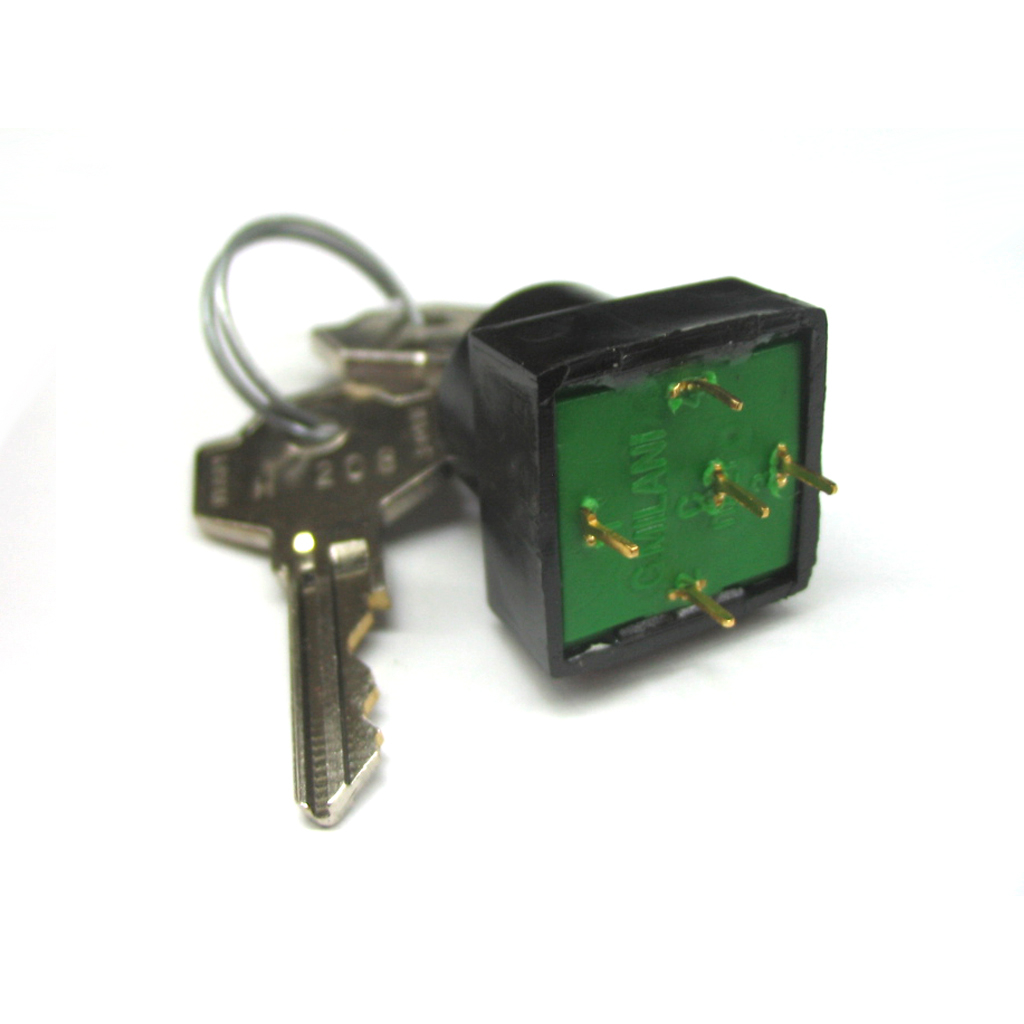
New rotary switch featuring FR‑4 sectors with gold‑plated tracks. This model completes the 6V series, offering 24 positions with a 15° detent angle and shorting contacts with solder terminals. It is particularly suitable for professional audio applications, where reliable shorting contact is required across all positions.

The switch adopts a new gold‑plated terminal design, with dimensions different from the standard 6VCS footprint. The dedicated DXF footprint is available for download.

Contact system

  • [Sliding‑brush contact system](ca://s?q=Explain_sliding_brush_contact_system)
  • [Movable end‑stop](ca://s?q=Explain_movable_end_stop_rotary_switch)
  • Shorting contacts only

Switching configurations

  • 1 pole — 24 positions per sector
  • 2 poles — 12 positions per sector
  • Maximum 4 sectors (standard sectors added at the end with terminals)
  • Detent angle: 15°

Mechanical characteristics

  • Detent torque: 1.5 or 2 kg·cm ([custom values](ca://s?q=Explain_custom_detent_torque_rotary_switch) available)
  • Height: 27.4 mm + 8.5 mm for each additional sector

Available versions

  • [HV version](ca://s?q=Explain_HV_rotary_switch_version) — insulated shaft in polyester/glass (max 4 sectors)
  • [Sealed version](ca://s?q=Explain_sealed_rotary_switch_version) — O‑ring on shaft, internal seal in threaded bushing, nitrile rubber washer for panel mounting

Electrical characteristics

  • Switching capacity: 200 mA @ 250 Vac / 400 mA @ 30 Vdc (resistive load)
  • Contact resistance: < 12 mΩ (+ track resistance)
  • Insulation to ground: 1300 Vac, 20 × 10⁹ Ω
  • Durability: > 120,000 operations (with load = 0.1 × maximum rating)
6VCS CC 6VCS CC
7VCS14 7VCS14

7VCS14

Up to 4 positions

90° detent angle

ESD-protected design

7VCS14 — Features

7VCS14 — Technical Details

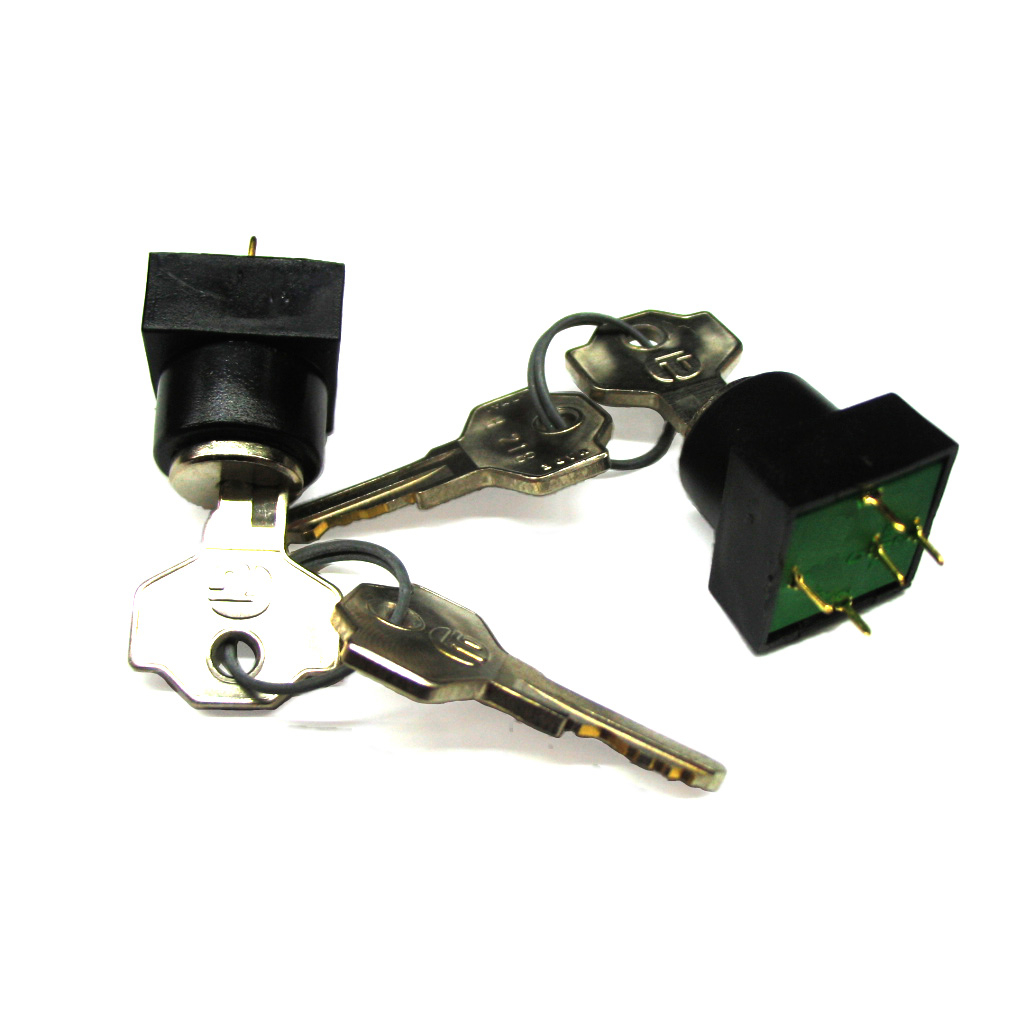
Compact signal rotary switches with low contact resistance, featuring an elastic brush contact system and fixed stop. All versions use non-shorting contacts and include key extraction in all positions.

Switching Configurations

  • 1 pole — 2 positions
  • 1 pole — 3 positions
  • 1 pole — 4 positions (continuous rotation)

Standard detent angle: 90°.

Mechanical Features

  • Elastic brush contact system
  • Fixed mechanical stop
  • Detent torque: 0.4–0.6 kg·cm
  • Key removable in all positions

ESD Protection

  • Compliant with EN 61000-4-2
  • Key-to-contact insulation: 8000 V (air), 4000 V (contact)

PCB Mounting

  • PCB hole diameter: 1.1 mm

Electrical & Mechanical Ratings

  • Switching capacity (resistive load): 0.2 A @ 220 Vac, 0.8 A @ 30 Vdc
  • Initial contact resistance: < 9 mΩ
  • Insulation between contacts: 1200 Vac, 30×10⁹ Ω
  • Mechanical life: > 100,000 operations (with load = 10% of rated value)
7VCS14 7VCS14
8V

8V

Up to 12 positions

Up to 4 sectors

With solder-lug terminals

8V — Features

8V — Technical Details

Solder-terminal rotary switches for signal applications, with molded sections and a sliding-shoe contact system. Equipped with internal movable stop and non-shorting contacts.

Switching configurations

  • 1 pole — 12 positions per section
  • 2 poles — 6 positions per section
  • 3 poles — 4 positions per section
  • Maximum: 4 sections

Standard detent angle: 30°. Detent angles of 60° or 90° available on request.

Mechanical features

  • Sliding-shoe contact system
  • Movable stop
  • Detent torque: 1.2–1.7 kg·cm (other values on request)

HV version (optional)

  • Insulated shaft in polyester-glass material (up to 2 sections)
  • Nylon mounting screws (up to 1 section)

Sealed version (optional)

  • Shaft O-ring
  • Internal seal inside threaded bushing
  • Nitrile rubber rear sealing washer

Dimensions

  • 1-section switch length: 23 mm
  • Add 7.62 mm for each additional section

Electrical & mechanical ratings

  • Switching capacity (resistive load): 0.2 A @ 110 Vac, 1.4 A @ 30 Vdc
  • Initial contact resistance: < 9 mΩ (plus track resistance)
  • Insulation contacts/ground: 1300 Vac, 150×10⁹ Ω
  • Insulation between poles: 900 Vac, 20×10⁹ Ω
  • Mechanical life: > 100,000 operations (with load = 10% of rated value)
8V 8V
8VCS

8VCS

Up to 12 positions

Up to 4 sectors

For PCB mounting

8VCS — Features

8VCS — Technical Details

Signal rotary switches with molded sections and a sliding-shoe contact system, equipped with internal movable stop. Available with non-shorting contacts (shorting version on request).

Switching configurations

  • 1 pole — 12 positions
  • 2 poles — 6 positions
  • 3 poles — 4 positions
  • Maximum: 4 sections

Standard detent angle: 30°. Detent angles of 60° or 90° available on request.

Mechanical features

  • Sliding-shoe contact system
  • Movable stop
  • Detent torque: 1.2 kg·cm (soft), 1.7 kg·cm (medium)

Dimensions

  • 1-section switch length: 23 mm
  • Add 7.62 mm for each additional section

HV version (optional)

  • Insulated shaft in polyester-glass material (up to 2 sections)
  • Nylon mounting screws (up to 1 section)

Sealed version (optional)

  • Shaft O-ring
  • Internal seal inside threaded bushing
  • Nitrile rubber rear sealing washer

Electrical & mechanical ratings

  • Switching capacity (resistive load): 0.2 A @ 220 Vac, 0.4 A @ 30 Vdc
  • Initial contact resistance: < 9 mΩ (plus track resistance)
  • Insulation contacts/ground: 1300 Vac, 150×10⁹ Ω
  • Insulation between poles: 900 Vac, 20×10⁹ Ω
  • Mechanical life: > 100,000 operations (with load = 10% of rated value)
8VCS 8VCS

📦 BASIC

3R 3R

3R

Up to 12 positions

Up to 2 poles

For PCB mounting

3R — Features

3R — Technical Details

The 3R rotary switch series includes single-pole and double-pole models with detent angles of 30°, 45°, 60° and 90°. Available configurations range from 1×12 positions to 2×2 positions, covering both economical and professional applications.

Available Models

  • 3R112 — 1 pole, 12 positions, 30° detent
  • 3R206 — 2 poles, 6 positions, 30° detent
  • 3R108 — 1 pole, 8 positions, 45° detent
  • 3R204 — 2 poles, 4 positions, 45° detent
  • 3R106 — 1 pole, 6 positions, 60° detent
  • 3R203 — 2 poles, 3 positions, 60° detent
  • 3R104 — 1 pole, 4 positions, 90° detent
  • 3R202 — 2 poles, 2 positions, 90° detent

Standard versions feature non-shorting contacts. Shorting versions are available only for 30° detent models by adding the suffix S (e.g., 3R112S, 3R206S).

Mechanical Features

  • Balanced roller contact system for stable tactile feedback
  • Internal adjustable stop; number of active positions defined at order
  • Standard detent torque: 0.8–1.2 kg·cm
  • Soft-spring detent torque: 0.5–0.7 kg·cm
  • Optional metal retaining ring increases axial shaft resistance from 20 kg to over 40 kg
  • Protective contact cap
  • Terminal holes: Ø 1.1 mm

Sealed Version

  • Shaft O-ring
  • Internal seal inside threaded bushing
  • Nitrile rubber rear sealing washer

Electrical & Mechanical Ratings

  • Switching capacity (resistive load): 1.5 A @ 230 Vac, 3 A @ 30 Vdc
  • Initial contact resistance: < 9 mΩ
  • Insulation between poles: 1200 Vac, 40×10⁹ Ω
  • Mechanical life: > 30,000 operations (with load = 10% of rated value)
3R 3R
10R 10R

10R

Up to 12 positions

Up to 4 poles

For PCB mounting

10R — Features

10R — Technical Details

The 10R rotary switch series includes 1- to 4-pole models with 30° detent angle and up to 11 positions. Designed for signal applications, the switches feature glass-filled nylon housings and fully inspectable internal construction.

Available Models

  • 10R111 — 1 pole, 11 positions, 30° detent
  • 10R206 — 2 poles, 6 positions, 30° detent
  • 10R304 — 3 poles, 4 positions, 30° detent
  • 10R403 — 4 poles, 3 positions, 30° detent

Standard versions feature non-shorting contacts. Shorting versions are available by adding the suffix S (e.g., 10R111S, 10R206S, 10R304S).

Mechanical Features

  • Gold-plated contacts
  • Elastic brush contact system
  • Movable stop
  • Protective contact cap
  • Standard detent torque: 1.0–1.2 kg·cm
  • Soft-spring detent torque (optional): 0.6–0.8 kg·cm
  • Optional metal retaining ring increases axial shaft resistance from 20 kg to over 40 kg

Available Options

  • Shaft extension up to 100 mm from panel surface
  • Alternative pole outputs (B and D instead of A and C) for 2-pole models
  • Custom shaft cuts and machining

Sealed Version

  • Shaft O-ring
  • Internal seal inside threaded bushing
  • Nitrile rubber rear sealing washer

Electrical & Mechanical Ratings

  • Switching capacity (resistive load): 200 mA @ 250 Vac, 400 mA @ 30 Vdc
  • Initial contact resistance: < 10 mΩ
  • Adjacent contact insulation: 1200 Vac, 20×10⁹ Ω
  • Pole-to-pole insulation: 1300 Vac, 22×10⁹ Ω
  • Operating temperature: –20 to +80 °C
  • Mechanical life: > 120,000 operations (with load = 10% of rated value)
10R 10R
11R 11R

11R

Up to 12 positions

Up to 4 poles

With solder-lug terminals

11R — Features

11R — Technical Details

The 11R rotary switch series includes 1- to 4-pole models with 30° detent angle and up to 11 positions. Designed for signal applications, the switches feature glass-filled nylon housings and fully inspectable internal construction.

Available Models

  • 11R111 — 1 pole, 11 positions, 30° detent
  • 11R206 — 2 poles, 6 positions, 30° detent
  • 11R304 — 3 poles, 4 positions, 30° detent
  • 11R403 — 4 poles, 3 positions, 30° detent

Standard versions feature non-shorting contacts. Shorting versions are available by adding the suffix S (e.g., 11R111S, 11R206S, 11R304S).

Mechanical Features

  • Gold-plated contacts
  • Elastic brush contact system
  • Movable stop
  • Protective contact cap
  • Standard detent torque: 1.0–1.2 kg·cm
  • Soft-spring detent torque (optional): 0.6–0.8 kg·cm
  • Optional metal retaining ring increases axial shaft resistance from 20 kg to over 40 kg

Available Options

  • Shaft extension up to 100 mm from panel surface
  • Custom shaft cuts and machining

Sealed Version (Optional)

  • Shaft O-ring
  • Internal seal inside threaded bushing
  • Nitrile rubber rear sealing washer

Electrical & Mechanical Ratings

  • Switching capacity (resistive load): 200 mA @ 250 Vac, 400 mA @ 30 Vdc
  • Initial contact resistance: < 10 mΩ
  • Adjacent contact insulation: 1300 Vac, 22×10⁹ Ω
  • Pole-to-pole insulation: 1200 Vac, 20×10⁹ Ω
  • Operating temperature: –20 to +80 °C
  • Mechanical life: > 120,000 operations (with load = 10% of rated value)
11R 11R
13R 13R

13R

Up to 12 positions

Up to 2 poles

For small domestic appliances

13R — Features

13R — Technical Details

The 13R rotary switch series includes single- and double-pole models with detent angles of 30°, 45°, 60° and 90°, offering up to 12 positions. Designed for signal applications, the switches feature a balanced roller contact system and fully inspectable internal construction.

Available Models

  • 13R112 — 1 pole, 12 positions, 30° detent
  • 13R206 — 2 poles, 6 positions, 30° detent
  • 13R108 — 1 pole, 8 positions, 45° detent
  • 13R204 — 2 poles, 4 positions, 45° detent
  • 13R106 — 1 pole, 6 positions, 60° detent
  • 13R203 — 2 poles, 3 positions, 60° detent
  • 13R104 — 1 pole, 4 positions, 90° detent
  • 13R202 — 2 poles, 2 positions, 90° detent

Standard versions feature non-shorting contacts.

Mechanical Features

  • Balanced roller contact system
  • Internal stop; number of active positions defined at order
  • Standard detent torque: 0.8–1.2 kg·cm
  • Soft-spring detent torque (optional): 0.5–0.7 kg·cm
  • Protective contact cap
  • Terminal holes: 0.9 × 1.8 mm

Wired Versions

  • Switches can be supplied fully wired with cable and connector
  • Cable type, color, length, sleeving and connectors according to customer drawing

Sealed Version

  • Shaft O-ring
  • Internal seal inside threaded bushing
  • Nitrile rubber rear sealing washer

Electrical & Mechanical Ratings

  • Switching capacity (resistive load): 1.5 A @ 220 Vac, 3 A @ 30 Vdc
  • Initial contact resistance: < 9 mΩ
  • Insulation between poles: 1200 Vac, 40×10⁹ Ω
  • Mechanical life: > 30,000 operations (with load = 10% of rated value)
13R 13R

✨ SPECIAL

CMT1

CMT1

LED position indication

Sequential relay switching

Configurable positions 2–9
CMT1 — Features

CMT1 — Technical Details

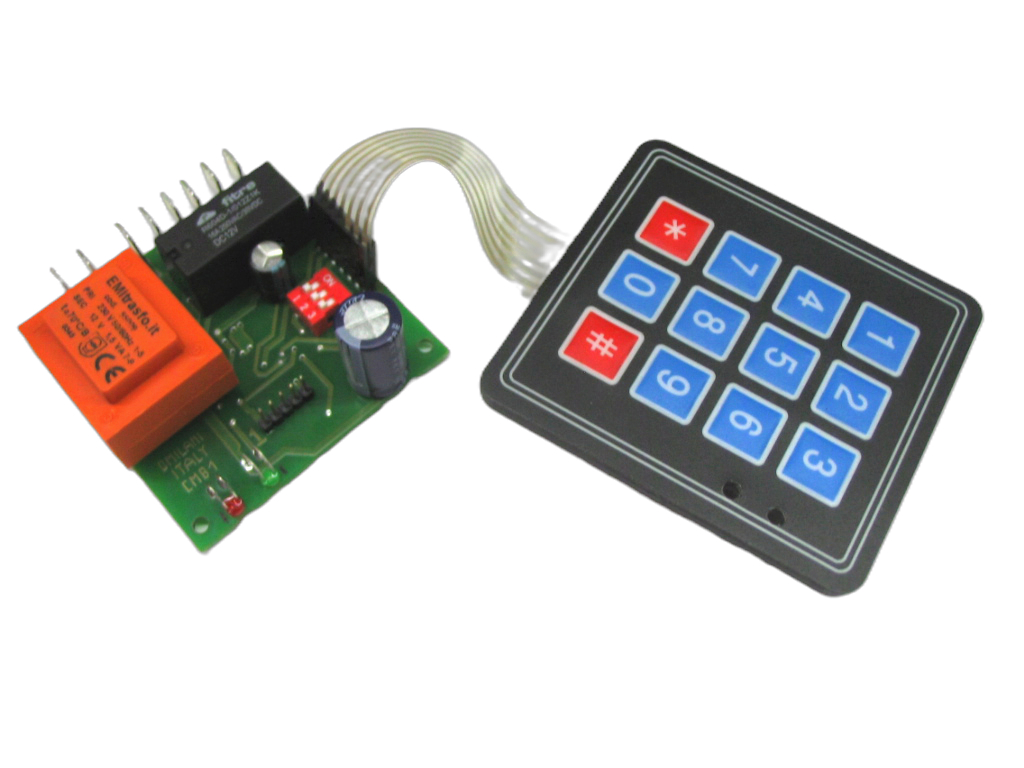
Electronic rotary relay selector with keypad control. Each key includes an integrated LED indicating the current active position. Board supply voltage: 12 Vac. Maximum contact current: 20 A @ 250 Vac.

Non-shorting operation (NC mode)

When powered, the system restores the last active position. Pressing a key (1–9) moves the selector sequentially through all intermediate relays until reaching the new target position. Each relay remains active for 0.2 seconds before advancing.

Shorting operation (CC mode)

When CC mode is enabled, the previously active relay remains energized for 0.2 seconds during transitions.

Selectable number of positions (2 to 9)

Using selector switches 1-2-3, the stop position can be configured from 2 to 9 positions:

  • 2 positions: 1 ON, 2 ON, 3 ON
  • 3 positions: 1 OFF, 2 ON, 3 ON
  • 4 positions: 1 ON, 2 OFF, 3 ON
  • 5 positions: 1 OFF, 2 OFF, 3 ON
  • 6 positions: 1 ON, 2 ON, 3 OFF
  • 7 positions: 1 OFF, 2 ON, 3 OFF
  • 8 positions: 1 ON, 2 OFF, 3 OFF
  • 9 positions: 1 OFF, 2 OFF, 3 OFF

Key “0” function (OFF mode)

The “0” key can be factory-configured in one of three modes:

  • Disabled — no function assigned.
  • Enabled, sequential OFF — moves the selector to position 0 passing through intermediate relays.
  • Enabled, immediate ON/OFF — instantly turns off the active relay and goes to 0; pressing again restores the last used position.
CMT1 CMT1
CMB1

CMB1

Three operating modes

Programmable 4-digit code

Dual-pole relay 16A

CMB1 — Features

CMB1 — Technical Details

The CMB1 is a 4-digit electronic combination key system that, once the code is entered, activates a 16 A double-throw relay in one of three selectable operating modes. Mode selection is performed via the on-board 3-position selector.

Operating modes

  • Fast mode — selector 1-2-3 OFF Relay activates for 2 seconds (ideal for electric locks).
  • Timed mode — selector 1 OFF, 2 ON, 3 OFF Relay activates for 60 seconds (customizable on request).
  • Continuous mode — selector 1 OFF, 2 OFF, 3 ON Relay remains active until the code is re-entered.

The keypad includes two LEDs (red and green) indicating system status. Power supply: 230 Vac. Relay rating: 16 A @ 250 Vac.

Programming a new code

  • Set selector 1 to ON → red LED turns on steadily (programming mode).
  • Enter the 4 digits of the new code (each keypress turns the red LED off for 0.5 s).
  • If more than 4 keys are pressed, only the first four are stored.
  • Set selector 1 back to OFF → red LED flashes 5 times and the relay activates for 1 second as confirmation.
  • If selector 1 is turned OFF before all digits are entered, programming is cancelled and the previous code remains valid.

Normal operation

  • To activate the relay: enter the code + #
  • To deactivate the relay: enter the code + *
CMB1 CMB1